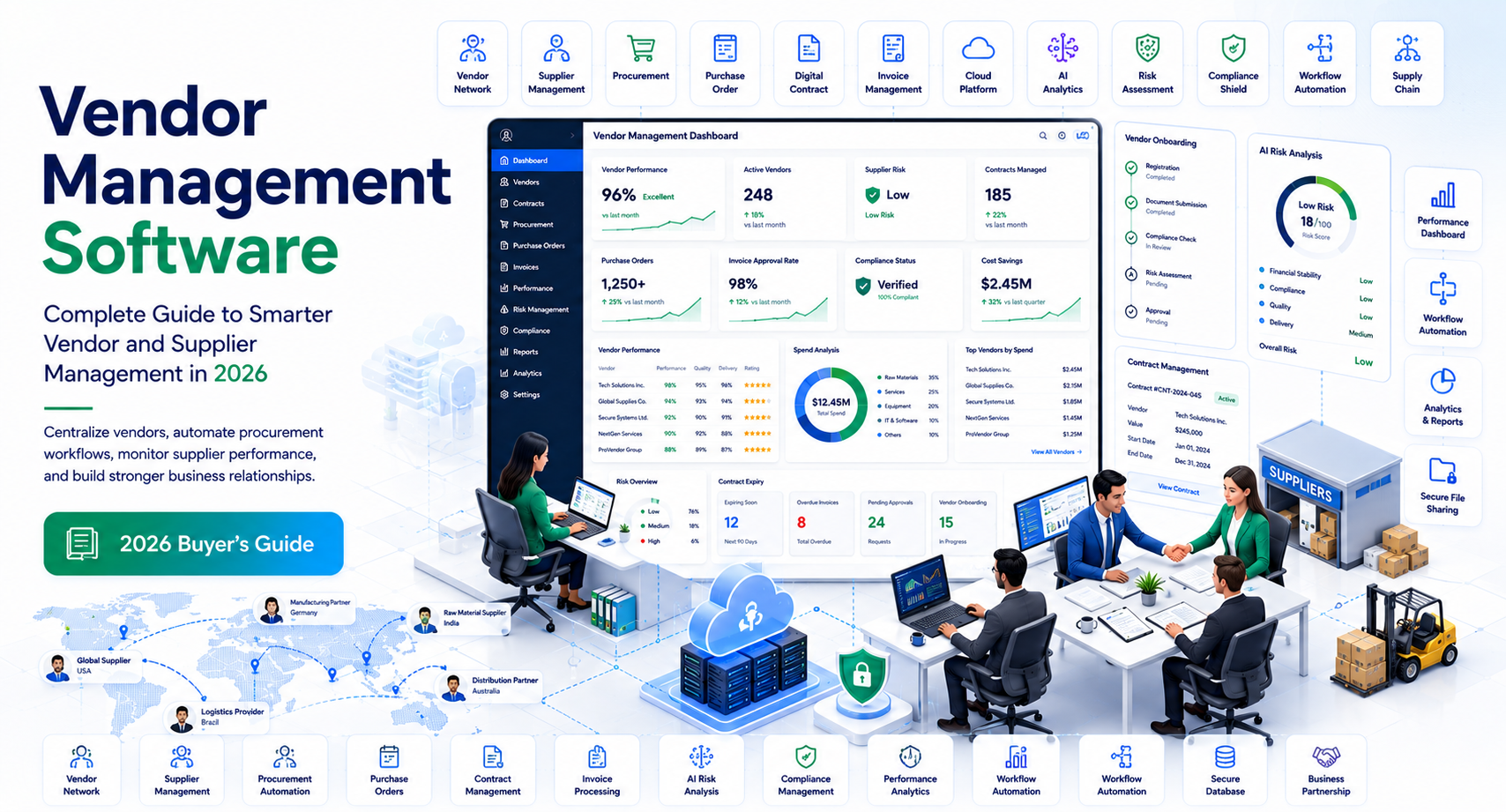
Vendor Management Software: Complete Guide to Smarter Vendor and Supplier Management in 2026
Managing vendors has become far more complex than simply tracking contracts and invoices. Modern businesses rely on dozens—or even thousands—of third-party vendors for software, logistics, manufacturing, marketing, IT services, and consulting. While these partnerships drive growth, they also introduce operational, financial, cybersecurity, and compliance risks.
Spreadsheets and email chains are no longer enough to manage vendor relationships effectively. Organizations need centralized systems that provide visibility into vendor performance, contract status, compliance requirements, and potential risks.
This is where vendor management software plays an important role.
A modern vendor management platform helps businesses organize vendor information, automate onboarding, monitor supplier performance, manage contracts, assess third-party risks, and simplify compliance processes—all from a single system.
Whether you’re a procurement manager, IT leader, finance professional, or business owner in the United States, this guide will explain how vendor management software works, why it matters, and what features to look for before choosing a solution.
In this guide, you’ll learn:
- What vendor management software is
- How vendor lifecycle management works
- Key business benefits
- Essential features
- Third-party risk and compliance considerations
- How to evaluate the right platform
What Is Vendor Management Software?
Vendor management software is a digital solution that helps organizations manage every stage of the vendor lifecycle, from onboarding and qualification to contract management, performance monitoring, risk assessment, and renewal.
Instead of storing supplier records across spreadsheets, emails, and multiple databases, businesses maintain a centralized repository containing vendor information, documentation, contracts, certifications, and performance data.
Depending on the platform, vendor management software may support:
- Vendor onboarding
- Supplier qualification
- Contract management
- Performance scorecards
- Risk assessments
- Compliance tracking
- Invoice management
- Procurement workflows
- Vendor communication
- Reporting and analytics
The goal is to improve collaboration with suppliers while reducing administrative effort and operational risk.
Why Vendor Management Matters
Most organizations depend on third-party vendors to support daily operations.
Examples include:
- Cloud software providers
- Marketing agencies
- Logistics companies
- Equipment suppliers
- IT service providers
- Manufacturing partners
- Professional consultants
- Staffing agencies
As vendor networks expand, businesses face new challenges:
- Inconsistent onboarding
- Poor contract visibility
- Missed renewal dates
- Security concerns
- Regulatory compliance issues
- Limited performance tracking
- Duplicate vendor records
Vendor management software helps address these issues through standardized workflows and centralized data management.
The Vendor Lifecycle Explained
Understanding the vendor lifecycle makes it easier to evaluate vendor management software.
Vendor Discovery
Organizations identify potential suppliers based on pricing, capabilities, certifications, and business requirements.
Many companies create standardized evaluation criteria to compare vendors objectively.
Vendor Qualification
Before approval, vendors often complete assessments covering:
- Business information
- Financial stability
- Insurance coverage
- Industry certifications
- Security practices
- Regulatory compliance
- References
Automating qualification reduces manual paperwork while improving consistency.
Vendor Onboarding
Once approved, vendors submit required documentation such as:
- Tax forms
- Banking information
- Service agreements
- Insurance certificates
- Compliance documentation
- Contact details
A structured onboarding process minimizes delays and ensures required information is collected before work begins.
Contract Management
Contracts define expectations regarding:
- Pricing
- Service levels
- Responsibilities
- Deliverables
- Renewal dates
- Termination clauses
Vendor management software stores these agreements in a searchable repository and can automatically notify stakeholders before contracts expire.
Performance Monitoring
Ongoing vendor evaluations help organizations measure:
- Service quality
- Delivery performance
- Responsiveness
- Cost efficiency
- Compliance status
- Customer satisfaction
Performance scorecards provide objective data that supports renewal and sourcing decisions.
Renewal or Offboarding
At the end of a contract, organizations decide whether to renew, renegotiate, or end the vendor relationship.
A structured offboarding process helps recover company assets, revoke system access, and ensure contractual obligations are completed.
Key Benefits of Vendor Management Software
Organizations that adopt vendor management software often improve operational efficiency while reducing risk.
Centralized Vendor Information
Instead of searching through emails or spreadsheets, employees can quickly access:
- Vendor profiles
- Contracts
- Certificates
- Contact information
- Performance reports
- Compliance records
A single source of truth reduces duplication and improves decision-making.
Improved Compliance
Many industries must comply with regulations governing vendor relationships.
Vendor management software helps track:
- Compliance documents
- Insurance renewals
- Certifications
- Audit records
- Policy acknowledgments
Automated reminders reduce the likelihood of missed deadlines.
Better Contract Visibility
Organizations frequently lose money because contracts renew automatically without review.
Contract management features help businesses:
- Track expiration dates
- Receive renewal notifications
- Monitor service-level agreements (SLAs)
- Store contract versions securely
This improves financial oversight and contract governance.
Stronger Vendor Relationships
Centralized communication, performance reviews, and standardized workflows create a more transparent relationship between businesses and suppliers.
Constructive performance discussions often lead to improved service quality.
Reduced Administrative Work
Automation simplifies repetitive tasks such as:
- Vendor onboarding
- Document collection
- Approval workflows
- Compliance reminders
- Contract renewals
- Performance reporting
Employees spend less time on manual administration and more time on strategic procurement activities.
Essential Features to Look For
Not every platform provides the same functionality.
The following features are among the most valuable when evaluating vendor management software.
Vendor Database
A centralized database should store:
- Contact information
- Contracts
- Certifications
- Risk assessments
- Payment details
- Communication history
Quick access to vendor information improves operational efficiency.
Workflow Automation
Automation reduces repetitive administrative work.
Examples include:
- Vendor approval requests
- Document collection
- Renewal notifications
- Risk assessments
- Contract routing
Workflow automation also improves process consistency.
Contract Management
An effective contract management module should support:
- Version control
- Renewal alerts
- Electronic signatures
- Searchable contracts
- Approval workflows
Strong contract governance helps reduce legal and financial risks.
Vendor Performance Dashboards
Performance dashboards provide measurable insights using metrics such as:
- Delivery times
- Quality scores
- SLA compliance
- Customer satisfaction
- Issue resolution times
These reports help procurement teams make informed sourcing decisions.
Risk Management
Risk management capabilities allow organizations to evaluate vendor risks before and during the relationship.
Common assessment areas include:
- Cybersecurity
- Financial stability
- Operational resilience
- Business continuity
- Regulatory compliance
- Data privacy
Continuous monitoring improves overall supplier resilience.
Reporting and Analytics
Advanced reporting helps organizations analyze:
- Vendor spending
- Contract status
- Procurement trends
- Risk exposure
- Supplier performance
- Compliance activities
These insights support more informed procurement strategies.
Understanding Third-Party Risk Management
As organizations increasingly rely on external vendors, third-party risk management has become a critical part of procurement.
A vendor’s cybersecurity incident, financial instability, or compliance failure can directly affect business operations.
Modern vendor management software often includes tools for assessing:
- Information security practices
- Data privacy controls
- Regulatory compliance
- Operational resilience
- Financial health
- Environmental, social, and governance (ESG) considerations
Rather than performing one-time reviews, many organizations now adopt continuous monitoring to identify emerging risks throughout the vendor relationship.
Privacy and Compliance Considerations
Large enterprises frequently require vendors to complete security and privacy documentation before gaining access to business systems or sensitive information.
For example, organizations researching topics such as the General Motors third party risk management software vendors privacy addendum are typically seeking information about enterprise privacy requirements that suppliers may need to meet during onboarding or contract negotiations.
Although each company maintains its own policies and documentation, similar enterprise privacy programs generally focus on areas such as:
- Data protection responsibilities
- Confidentiality obligations
- Security controls
- Incident reporting procedures
- Data processing requirements
- Regulatory compliance
- Third-party audit rights
Vendor management software helps track these documents, automate review processes, and ensure required records remain current throughout the vendor relationship.
How to Choose the Right Vendor Management Software
Selecting the right platform requires more than comparing feature lists.
Consider the following factors before making a decision.
Business Requirements
Start by identifying your priorities.
For example:
- Vendor onboarding
- Contract management
- Risk monitoring
- Procurement workflows
- Compliance management
- Performance tracking
Understanding your requirements helps narrow the list of potential solutions.
Scalability
Choose software that can support additional vendors, users, departments, and locations as your organization grows.
Scalable platforms reduce the need for costly system replacements in the future.
Integration Capabilities
The software should integrate with existing business systems such as:
- ERP platforms
- Procurement software
- Accounting software
- CRM systems
- Identity management solutions
- Document management systems
Strong integrations reduce duplicate work and improve data accuracy.
Ease of Use
Even the most feature-rich solution will struggle if employees find it difficult to use.
Evaluate:
- Dashboard design
- Search functionality
- Workflow simplicity
- Mobile accessibility
- Reporting tools
- User training resources
An intuitive interface encourages organization-wide adoption.
Internal Linking Opportunity: Link to related guides on Procurement Software, Contract Management Software, Supply Chain Management Software, Enterprise Resource Planning (ERP), Governance, Risk, and Compliance (GRC) Software, or Third-Party Risk Management Software.
Best Vendor Management Software in 2026
The right vendor management platform depends on your organization’s size, procurement process, compliance requirements, and industry. Some solutions focus primarily on procurement and supplier onboarding, while others include advanced contract management, third-party risk assessment, and performance analytics.
Below are some of the most widely used vendor management solutions in 2026.
1. SAP Ariba
Best for: Large enterprises with complex procurement operations
SAP Ariba provides a comprehensive supplier management ecosystem that supports sourcing, procurement, contract management, supplier collaboration, and spend analysis.
Key Features
- Supplier lifecycle management
- Contract management
- Procurement automation
- Supplier risk monitoring
- Spend analytics
- ERP integration
Pros
- Enterprise-grade functionality
- Extensive supplier network
- Strong reporting capabilities
Considerations
- Implementation can be complex for smaller businesses.
2. Coupa Supplier Management
Best for: Organizations focused on spend management
Coupa combines procurement, supplier management, expense tracking, and business spend analytics into a unified platform.
Key Features
- Supplier onboarding
- Risk assessments
- Contract visibility
- Compliance tracking
- Automated approvals
- Spend optimization
Pros
- Strong financial insights
- User-friendly dashboards
- Excellent workflow automation
3. Oracle Fusion Cloud Procurement
Best for: Large organizations using Oracle’s business applications
Oracle offers vendor management capabilities integrated with procurement, finance, sourcing, and ERP systems.
Key Features
- Supplier qualification
- Contract management
- Supplier portals
- Purchasing automation
- Procurement analytics
Pros
- Highly scalable
- Strong enterprise integrations
- Advanced reporting
4. Gatekeeper
Best for: Mid-sized businesses seeking contract and vendor management
Gatekeeper focuses on simplifying vendor relationships through centralized contract storage, automated workflows, and supplier collaboration.
Key Features
- Vendor database
- Contract lifecycle management
- Approval workflows
- Automated reminders
- Performance tracking
Pros
- Easy implementation
- Clean interface
- Strong contract management
5. Ivalua
Best for: Global procurement teams
Ivalua provides an end-to-end source-to-pay platform with comprehensive supplier lifecycle management capabilities.
Key Features
- Supplier onboarding
- Risk management
- Contract management
- Procurement automation
- Supplier performance analytics
Pros
- Flexible workflows
- Comprehensive procurement capabilities
- Strong scalability
6. Precoro
Best for: Small and medium-sized businesses
Precoro helps growing businesses simplify purchasing, vendor management, and budget control without the complexity of enterprise software.
Key Features
- Purchase order management
- Vendor database
- Approval workflows
- Budget tracking
- Procurement reporting
Pros
- Affordable
- Easy to learn
- Fast deployment
How Much Does Vendor Management Software Cost?
Pricing varies based on several factors, including company size, number of vendors, deployment model, and feature requirements.
Common pricing factors include:
- Number of users
- Number of vendors
- Contract volume
- Workflow automation
- Risk management capabilities
- Integrations
- Customer support
- Implementation services
Small businesses often choose subscription-based cloud solutions with predictable monthly costs, while enterprise organizations typically receive custom pricing tailored to their procurement and compliance requirements.
When evaluating software, consider the total cost of ownership (TCO), including implementation, training, data migration, integrations, and ongoing maintenance—not just the subscription fee.
Best Practices for Successful Implementation
Deploying vendor management software successfully requires thoughtful planning and stakeholder involvement.
Standardize Vendor Data
Before migrating to a new system, clean and organize existing vendor records.
Remove:
- Duplicate suppliers
- Outdated contacts
- Expired contracts
- Incomplete records
Accurate data improves reporting and workflow efficiency from the start.
Define Vendor Policies
Document clear policies for:
- Vendor onboarding
- Risk assessments
- Contract approvals
- Performance reviews
- Renewal processes
- Offboarding procedures
Standardized policies create consistency across departments.
Automate Routine Processes
Automation can significantly reduce manual work.
Examples include:
- Document requests
- Compliance reminders
- Contract renewal notifications
- Approval routing
- Vendor scorecard generation
Automation also minimizes the risk of missed deadlines and administrative errors.
Train Employees
Provide role-specific training for procurement teams, finance staff, legal departments, and vendor managers.
Training should cover:
- Vendor onboarding
- Contract management
- Reporting
- Risk assessment workflows
- Dashboard usage
- Approval processes
Well-trained users are more likely to adopt the platform effectively.
Monitor Key Performance Indicators (KPIs)
Track measurable outcomes to evaluate the success of your vendor management program.
Common KPIs include:
- Vendor onboarding time
- Contract renewal rate
- Supplier performance score
- Procurement cycle time
- Compliance completion rate
- Vendor issue resolution time
- Cost savings achieved
Regular performance reviews help identify opportunities for continuous improvement.
Common Mistakes to Avoid
Many organizations fail to maximize the value of vendor management software because of avoidable mistakes.
Treating It as Only a Procurement Tool
Vendor management extends beyond purchasing. It also supports compliance, risk management, contract administration, performance evaluation, and strategic supplier relationships.
Neglecting Third-Party Risk Assessments
Cybersecurity, financial stability, regulatory compliance, and operational resilience should be evaluated throughout the vendor relationship—not only during onboarding.
Continuous monitoring helps identify emerging risks before they affect business operations.
Overlooking Contract Deadlines
Missed renewals or unnoticed automatic extensions can increase costs and reduce negotiating leverage.
Automated alerts help procurement teams stay ahead of important contract milestones.
Ignoring Employee Adoption
Even the most capable platform delivers limited value if employees continue relying on spreadsheets or manual processes.
Leadership support, user training, and clear governance are essential for successful adoption.
Choosing Software Without Integration Capabilities
A disconnected vendor management system often creates duplicate work and inconsistent data.
Look for solutions that integrate with ERP systems, accounting software, procurement platforms, document management systems, and identity management tools.
Future Trends in Vendor Management
Vendor management continues to evolve as organizations prioritize resilience, compliance, and data-driven decision-making.
Artificial Intelligence
AI is increasingly used to:
- Analyze supplier performance
- Identify contract risks
- Detect spending anomalies
- Recommend preferred vendors
- Prioritize high-risk suppliers
These capabilities help procurement teams make faster and more informed decisions.
Continuous Third-Party Risk Monitoring
Rather than relying on annual assessments, many organizations now monitor vendors continuously using automated risk indicators and external intelligence sources.
This approach provides earlier visibility into potential issues.
ESG and Sustainability Reporting
Environmental, Social, and Governance (ESG) considerations are becoming an important part of vendor evaluations.
Organizations increasingly assess suppliers based on:
- Environmental practices
- Labor standards
- Ethical sourcing
- Diversity initiatives
- Corporate governance
Vendor management software is evolving to track these metrics alongside traditional performance indicators.
Greater Workflow Automation
Automation is expanding beyond approvals to include supplier onboarding, document verification, contract lifecycle management, and performance reporting.
This reduces manual effort while improving process consistency.
Enhanced Data Privacy and Security
As businesses share more sensitive information with external vendors, software providers continue to strengthen security through:
- Role-based access controls
- Multi-factor authentication
- Encryption
- Audit trails
- Secure document management
These capabilities help organizations meet evolving privacy and compliance requirements.
May you like : Corporate Software Inspector: Complete Guide for Businesses in 2026
Frequently Asked Questions
What is vendor management software?
Vendor management software is a centralized platform that helps businesses manage supplier information, contracts, onboarding, performance, compliance, and third-party risk throughout the vendor lifecycle.
What are the benefits of vendor management software?
Key benefits include improved supplier visibility, streamlined onboarding, better contract management, stronger compliance, reduced operational risk, workflow automation, and enhanced vendor performance monitoring.
Is vendor management software suitable for small businesses?
Yes. Many cloud-based platforms are designed specifically for small and medium-sized businesses and offer scalable features that can grow alongside the organization.
How does vendor management software support compliance?
The software tracks certifications, contracts, insurance documents, audit records, and regulatory requirements while providing reminders for renewals and missing documentation.
How is vendor management different from procurement software?
Procurement software primarily focuses on purchasing goods and services. Vendor management software covers the broader supplier lifecycle, including onboarding, contracts, performance management, compliance, and third-party risk.
Conclusion
As organizations depend on an expanding network of suppliers, managing vendor relationships has become a strategic business priority. Vendor management software helps centralize vendor data, automate repetitive processes, strengthen compliance, improve supplier performance, and reduce third-party risk.
Whether your organization manages a handful of suppliers or a global vendor network, selecting the right platform requires careful evaluation of your operational needs, integration requirements, scalability, and governance objectives. Businesses operating in highly regulated industries should also ensure that the software supports privacy documentation, security reviews, and third-party risk assessments required by enterprise customers.
The next step is to assess your current vendor management process, identify manual bottlenecks, and compare platforms that align with your procurement strategy. You may also find it helpful to explore related guides on procurement software, contract lifecycle management software, third-party risk management, GRC software, and supply chain management software to build a more connected and resilient vendor management program.