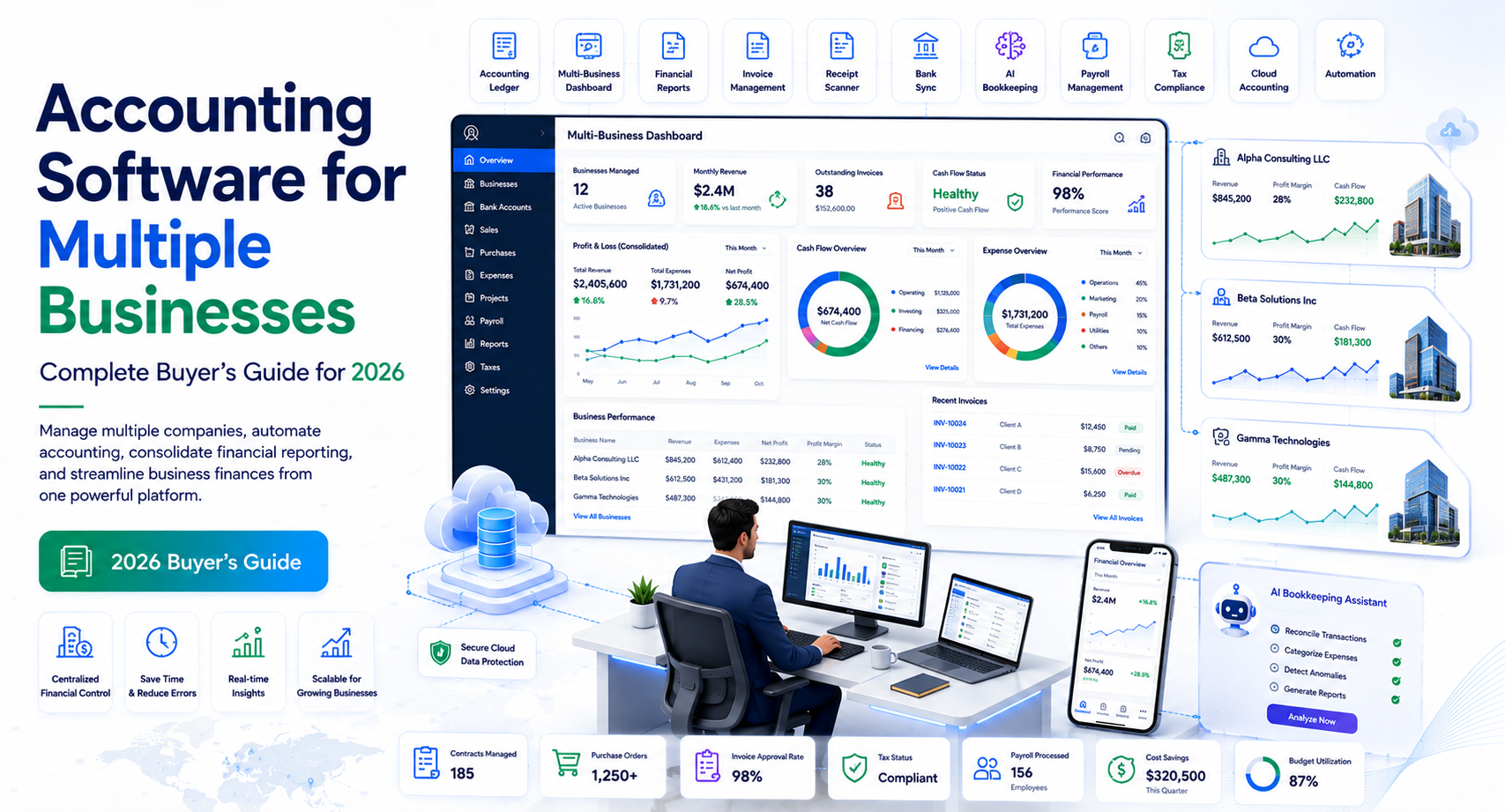
Accounting Software for Multiple Businesses: Complete Buyer’s Guide for 2026
Managing the finances of one business is challenging enough. Managing two, five, or even dozens of companies introduces a whole new level of complexity. Each business may have its own bank accounts, tax requirements, employees, invoices, vendors, and financial reports. Trying to keep everything organized using spreadsheets or separate accounting systems quickly becomes inefficient and increases the risk of costly mistakes.
This is where accounting software for multiple businesses becomes essential.
Modern accounting platforms allow business owners, accountants, and finance teams to manage multiple legal entities from a single solution while keeping each company’s financial records separate and secure. Many platforms also support consolidated reporting, automated workflows, user permissions, and integrations with banking, payroll, and tax systems.
Whether you’re an entrepreneur operating several businesses, an accounting firm serving multiple clients, or a growing company with multiple subsidiaries across the United States, choosing the right software can save time, improve accuracy, and simplify financial management.
In this guide, you’ll learn:
- What accounting software for multiple businesses is
- Who should use it
- Key features to look for
- Benefits of multi-entity accounting
- How to choose the right solution
- What to consider before investing
What Is Accounting Software for Multiple Businesses?
Accounting software for multiple businesses is a financial management platform that allows users to manage the accounting records of two or more companies from a single system while maintaining separate books for each entity.
Unlike basic accounting software designed for a single company, multi-business accounting solutions let users switch between companies without maintaining completely separate software installations or duplicate workflows.
Depending on the platform, businesses can manage:
- General ledger
- Accounts payable
- Accounts receivable
- Banking
- Payroll
- Inventory
- Fixed assets
- Financial reporting
- Budgeting
- Tax preparation
Many cloud-based solutions also support secure collaboration between finance teams, external accountants, and business owners.
Who Needs Multi-Business Accounting Software?
Managing multiple entities is common across many industries.
Organizations that benefit include:
Entrepreneurs
Business owners often operate multiple companies under different legal entities.
Examples include:
- Retail stores
- E-commerce businesses
- Real estate investments
- Consulting firms
- Holding companies
Using one platform simplifies financial oversight across all businesses.
Accounting Firms
Accounting professionals frequently manage bookkeeping and financial reporting for multiple clients.
Instead of maintaining separate systems for each client, multi-business software centralizes administration while keeping client data isolated.
Franchise Owners
Franchise operators often manage several locations that require separate accounting records while also monitoring overall business performance.
Consolidated reporting makes financial analysis much easier.
Corporate Groups
Organizations with parent companies and subsidiaries need software capable of handling multiple entities while supporting consolidated financial reporting.
Property Management Companies
Real estate businesses frequently manage financial records for multiple properties, investment groups, or legal entities.
Dedicated multi-entity accounting simplifies rent tracking, expense allocation, and financial reporting.
Why Businesses Need Accounting Software for Multiple Companies
As organizations grow, financial management becomes increasingly complex.
Without specialized software, businesses often experience:
- Duplicate data entry
- Inconsistent reporting
- Difficulty switching between companies
- Increased accounting errors
- Poor financial visibility
- Time-consuming reconciliations
Managing each company separately also increases administrative costs.
Multi-business accounting software solves these challenges by providing centralized management while maintaining accurate records for every legal entity.
Key Benefits of Accounting Software for Multiple Businesses
The right accounting platform offers much more than bookkeeping.
Centralized Financial Management
Users can access multiple companies from one dashboard without logging into different systems.
This improves efficiency while reducing administrative complexity.
Separate Books for Each Business
Although companies are managed within one platform, each business maintains:
- Individual chart of accounts
- Bank accounts
- Customers
- Vendors
- Tax records
- Financial statements
This separation supports accurate reporting and regulatory compliance.
Consolidated Financial Reporting
Many organizations need an overall financial picture across multiple businesses.
Consolidated reporting combines financial information from multiple entities into unified reports for management, investors, or lenders.
Common consolidated reports include:
- Profit and loss
- Balance sheet
- Cash flow statement
- Budget performance
- Revenue analysis
Improved Productivity
Automation reduces repetitive accounting tasks such as:
- Bank reconciliation
- Invoice generation
- Payment reminders
- Expense categorization
- Financial reporting
Finance teams spend less time on manual work and more time analyzing business performance.
Better Decision-Making
Real-time dashboards provide insights into:
- Revenue trends
- Cash flow
- Outstanding invoices
- Expenses
- Profitability
- Business performance
Decision-makers gain greater visibility across all companies.
Essential Features to Look For
Not every accounting platform supports multi-business management equally well.
The following features should be considered during evaluation.
Multi-Entity Management
The software should allow users to:
- Create multiple companies
- Switch between entities easily
- Maintain separate accounting records
- Share users securely
- Generate entity-specific reports
This is the foundation of effective multi-business accounting.
Consolidated Reporting
Businesses with multiple entities often require group-level reporting.
Look for software capable of generating consolidated:
- Financial statements
- Budget reports
- Profitability analysis
- Cash flow reports
Automatic consolidation reduces manual spreadsheet work.
Bank Integration
Automatic bank feeds simplify reconciliation.
The software should connect securely with financial institutions to import transactions automatically.
This saves time while improving data accuracy.
Accounts Payable and Receivable
Effective accounting software should streamline both outgoing and incoming payments.
Features may include:
- Invoice creation
- Bill management
- Payment reminders
- Vendor payments
- Customer statements
- Payment tracking
Automation helps improve cash flow management.
User Permissions
Different employees require different levels of access.
Role-based permissions allow businesses to control who can:
- View reports
- Process payments
- Approve expenses
- Manage payroll
- Edit financial records
Strong permission controls improve internal security.
Budgeting and Forecasting
Budget management helps organizations plan future growth.
Many platforms include:
- Budget creation
- Forecasting
- Variance analysis
- Scenario planning
These tools support better financial decision-making.
Tax Management
Businesses operating across multiple states or entities often face complex tax requirements.
Accounting software should support:
- Sales tax
- Tax reporting
- Tax categories
- Year-end reporting
- Accountant collaboration
Proper tax management reduces compliance risks.
Third-Party Integrations
Look for platforms that integrate with:
- Payroll software
- CRM systems
- Inventory management
- Payment gateways
- Banking platforms
- E-commerce software
These integrations eliminate duplicate data entry while improving workflow efficiency.
Multi-Entity Accounting Explained
One of the biggest advantages of modern accounting platforms is support for multi-entity accounting.
Instead of maintaining separate accounting environments for each business, finance teams manage all entities within one secure system.
Each company maintains its own:
- Financial records
- Tax settings
- Bank accounts
- Customers
- Vendors
- Reporting structure
Meanwhile, authorized users can generate consolidated reports that provide an overall view of organizational performance.
This capability is particularly valuable for:
- Holding companies
- Parent organizations
- Franchise groups
- Investment firms
- Multi-location businesses
How to Choose the Best Accounting Software for Multiple Businesses
Every organization has different accounting requirements.
Before choosing a platform, consider the following factors.
Number of Companies
Some software limits the number of businesses included in standard pricing plans.
Confirm that the platform can support future growth.
Industry Requirements
Construction companies, healthcare providers, nonprofits, manufacturers, retailers, and professional service firms often require specialized accounting features.
Industry-specific functionality may improve efficiency.
Cloud vs. Desktop
Cloud-based software offers:
- Remote access
- Automatic updates
- Real-time collaboration
- Mobile compatibility
Desktop software may provide greater local control but often requires more maintenance.
Many growing businesses in the United States now prefer cloud accounting solutions because they simplify collaboration with accountants, bookkeepers, and remote finance teams.
Ease of Use
Powerful software should also be easy to learn.
During product evaluations, assess:
- Dashboard design
- Navigation
- Reporting interface
- Mobile experience
- Customer support
- Learning resources
An intuitive platform reduces onboarding time and encourages organization-wide adoption.
Scalability
Your accounting system should continue supporting your organization as you add:
- New companies
- Employees
- Customers
- Vendors
- Locations
Selecting scalable software reduces the need for expensive migrations later.
Internal Linking Opportunity: Link to related resources such as Accounting Software, ERP Software, Payroll Software, Invoice Management Software, Expense Management Software, Financial Reporting Software, or Small Business Accounting Software.
Best Accounting Software for Multiple Businesses in 2026
The ideal accounting solution depends on the size of your organization, the number of companies you manage, reporting requirements, and your budget. Some platforms are designed for small businesses with a handful of entities, while others support enterprise-level financial consolidation across hundreds of companies.
Below are some of the most popular options in 2026.
1. QuickBooks Online Advanced
Best for: Small and growing businesses
QuickBooks Online Advanced is widely used by businesses that need powerful accounting features with an easy-to-use interface. While separate company files are required, accountants and business owners can switch between companies efficiently.
Key Features
- Bank reconciliation
- Custom reporting
- Automated workflows
- Invoice management
- Expense tracking
- User permissions
Pros
- Beginner-friendly interface
- Large ecosystem of integrations
- Strong accountant support
Considerations
- Managing many companies may require multiple subscriptions.
2. Xero
Best for: Businesses with international operations
Xero offers cloud-based accounting with excellent collaboration features and support for multiple organizations under a single login.
Key Features
- Unlimited users
- Bank feeds
- Inventory management
- Financial reporting
- Fixed asset tracking
- Payroll integrations
Pros
- Clean user interface
- Strong automation
- Excellent mobile experience
3. Sage Intacct
Best for: Mid-sized businesses and multi-entity organizations
Sage Intacct is built for companies that require advanced financial management and consolidated reporting across multiple legal entities.
Key Features
- Multi-entity accounting
- Automated consolidations
- Revenue recognition
- Budgeting
- Dashboards
- AI-powered reporting
Pros
- Powerful financial controls
- Excellent scalability
- Strong compliance capabilities
4. NetSuite ERP
Best for: Large enterprises
NetSuite combines ERP and accounting into a unified cloud platform suitable for organizations with multiple subsidiaries.
Key Features
- Global financial management
- Multi-currency support
- Consolidated reporting
- Procurement
- Inventory management
- Business intelligence
Pros
- Enterprise-grade functionality
- Highly scalable
- Extensive automation
5. FreshBooks
Best for: Freelancers and service-based businesses
FreshBooks focuses on invoicing, time tracking, and expense management while supporting businesses that operate multiple brands or client-facing entities.
Key Features
- Online invoicing
- Time tracking
- Expense management
- Client portal
- Financial reports
Pros
- Very easy to use
- Excellent customer experience
- Fast implementation
6. Zoho Books
Best for: Small businesses looking for affordability
Zoho Books provides comprehensive accounting capabilities with seamless integration into the broader Zoho ecosystem.
Key Features
- Banking automation
- Invoice management
- Tax compliance
- Workflow automation
- Financial dashboards
Pros
- Competitive pricing
- Strong automation
- Easy integration with other Zoho applications
How Much Does Accounting Software for Multiple Businesses Cost?
Pricing varies based on the software vendor and the level of functionality you need.
Common pricing factors include:
- Number of companies
- Number of users
- Cloud or desktop deployment
- Reporting capabilities
- Payroll integration
- Inventory management
- Customer support
- Data storage
Some vendors charge per company, while others price based on users or feature tiers. Enterprise solutions often provide custom pricing based on organizational complexity.
When comparing options, consider the total cost of ownership (TCO), including implementation, staff training, integrations, and future upgrades—not just the monthly subscription.
Best Practices for Successful Implementation
Choosing the right software is only part of the process. Proper implementation is essential to achieve long-term value.
Clean Existing Financial Data
Before migrating, review your accounting records.
Remove:
- Duplicate customer records
- Inactive vendors
- Old chart of accounts
- Incorrect balances
- Outdated transactions
Clean data helps prevent reporting errors after migration.
Standardize Your Chart of Accounts
If you manage multiple businesses, using a consistent chart of accounts makes consolidated reporting much easier.
Standardization also simplifies budgeting, forecasting, and financial analysis across entities.
Define User Roles
Not every employee needs access to every company or financial function.
Use role-based permissions to control access based on responsibilities, such as:
- Bookkeeper
- Finance manager
- Controller
- Business owner
- External accountant
This improves both security and operational efficiency.
Automate Routine Accounting Tasks
Modern accounting software can automate many repetitive processes, including:
- Bank reconciliations
- Invoice reminders
- Recurring invoices
- Expense categorization
- Financial reporting
- Payment notifications
Automation reduces manual work while improving consistency.
Train Your Finance Team
Even intuitive software requires onboarding.
Training should cover:
- Company switching
- Report generation
- Bank reconciliation
- Budget management
- User permissions
- Dashboard navigation
Regular refresher sessions help employees make full use of new features as the software evolves.
Common Mistakes to Avoid
Businesses often encounter problems during implementation because of avoidable decisions.
Choosing Software That Doesn’t Scale
A solution that works for two companies today may struggle when your organization expands to ten or twenty entities.
Choose software that supports long-term growth.
Ignoring Reporting Requirements
Many businesses discover too late that their software cannot generate the consolidated reports required by management or investors.
Confirm reporting capabilities before making a purchase.
Underestimating Data Migration
Migrating financial records requires careful planning and validation.
Allocate enough time to verify balances, transactions, and historical data before going live.
Overlooking Integrations
Disconnected systems increase manual work and the risk of data inconsistencies.
Look for software that integrates with payroll, CRM, inventory, payment processing, and banking platforms.
Skipping Regular Financial Reviews
Accounting software provides valuable insights only if financial reports are reviewed consistently.
Schedule monthly and quarterly reviews to evaluate:
- Cash flow
- Profitability
- Outstanding receivables
- Budget performance
- Business growth
Trends Shaping Multi-Business Accounting in 2026
Accounting technology continues to evolve rapidly.
AI-Assisted Bookkeeping
Artificial intelligence is helping finance teams automate transaction categorization, detect unusual entries, reconcile accounts, and generate financial insights.
Real-Time Financial Dashboards
Business owners increasingly rely on live dashboards instead of waiting for month-end reports.
Real-time visibility supports faster and more informed decision-making.
Cloud-First Accounting
Cloud accounting has become the preferred choice for many organizations because it enables secure access from anywhere and simplifies collaboration between business owners, accountants, and finance teams.
Greater Automation
Automation is expanding into areas such as approval workflows, invoice processing, payment scheduling, and financial reporting.
These improvements reduce administrative workload while improving accuracy.
Enhanced Security
Accounting software vendors continue to strengthen security through:
- Multi-factor authentication
- Data encryption
- Audit trails
- Role-based access controls
- Automatic backups
These features help protect sensitive financial information.
Frequently Asked Questions
What is accounting software for multiple businesses?
It is accounting software that allows you to manage the financial records of multiple companies from one platform while keeping each entity’s books separate and secure.
What is the best accounting software for multiple businesses?
The best choice depends on your needs. QuickBooks Online Advanced, Xero, Sage Intacct, NetSuite ERP, Zoho Books, and FreshBooks are all strong options for different business sizes and budgets.
Can small businesses use multi-entity accounting software?
Yes. Many cloud-based accounting platforms offer affordable plans that support entrepreneurs, franchise owners, accounting firms, and businesses operating multiple legal entities.
What features are most important?
Look for multi-entity management, consolidated reporting, bank integrations, automation, budgeting, tax support, user permissions, and integrations with payroll or CRM software.
Is cloud accounting better than desktop accounting?
For most modern businesses, cloud accounting offers greater flexibility, easier collaboration, automatic updates, and secure remote access. However, some organizations may still prefer desktop solutions because of specific operational or compliance requirements.
May you like : Corporate Software Inspector: Complete Guide for Businesses in 2026
Conclusion
As businesses expand into new markets, launch additional brands, or acquire subsidiaries, managing multiple sets of financial records becomes increasingly complex. Investing in the right accounting software for multiple businesses helps simplify operations by centralizing financial management while maintaining separate books for each company.
The best solution should provide reliable multi-entity accounting, consolidated reporting, automation, secure user permissions, and seamless integrations with the other systems your business relies on every day. Rather than focusing solely on price, evaluate scalability, reporting capabilities, ease of use, customer support, and long-term value.
If you’re comparing the best accounting software for multiple businesses, start by identifying your current challenges, testing shortlisted platforms through free trials or demonstrations, and involving your finance team in the decision-making process. You can also explore related resources on ERP software, small business accounting software, payroll software, expense management software, financial reporting tools, and invoice management software to build a more connected and efficient financial technology stack.