
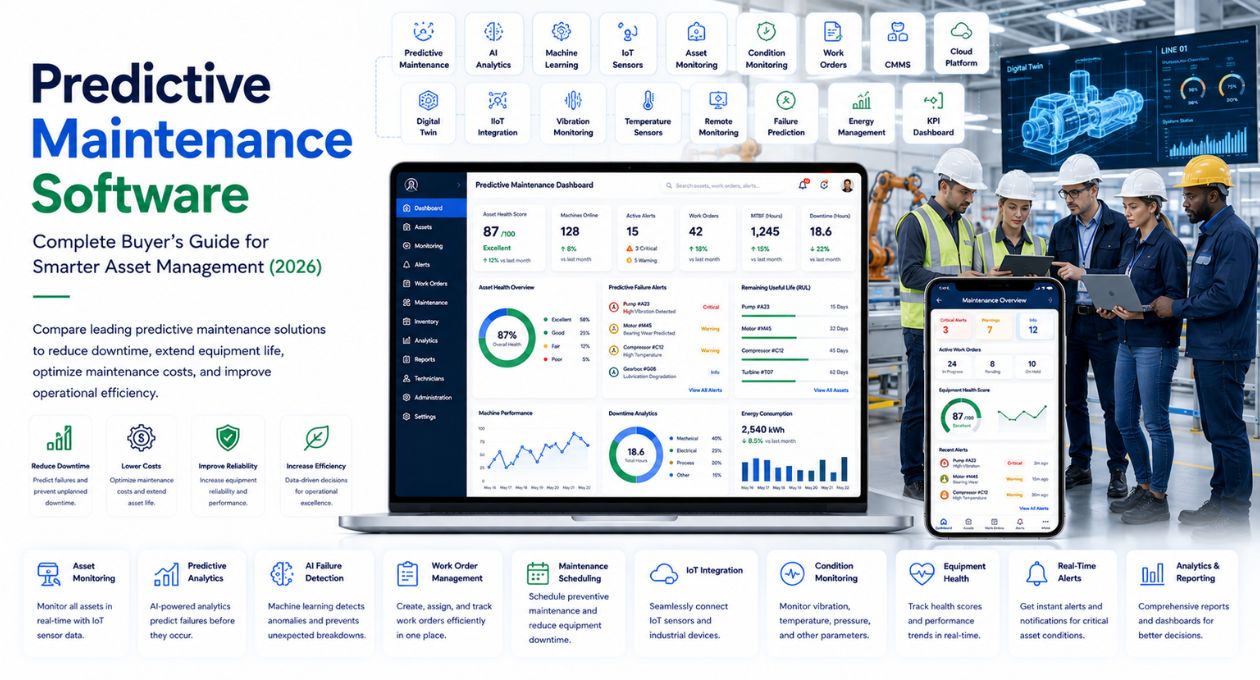
Predictive Maintenance Software: Complete Buyer’s Guide for Smarter Asset Management (2026)
Unexpected equipment failures can bring business operations to a halt. A single breakdown in a manufacturing plant, warehouse, energy facility, or transportation network can lead to production delays, costly repairs, safety concerns, and lost revenue.
Traditional maintenance strategies often fall into two categories. Reactive maintenance waits until equipment fails before repairs begin, while preventive maintenance relies on fixed schedules regardless of the actual condition of the asset. Although preventive maintenance is an improvement, it can still lead to unnecessary servicing or unexpected failures between scheduled inspections.
This is where predictive maintenance software offers a smarter approach.
By combining Industrial Internet of Things (IIoT) sensors, real-time monitoring, machine learning, and advanced analytics, predictive maintenance software helps organizations identify potential equipment issues before they become costly failures. Instead of guessing when maintenance is needed, businesses can make data-driven decisions based on the actual condition of their assets.
In this guide, you’ll learn:
- What predictive maintenance software is
- How it works
- The key technologies behind predictive maintenance
- Benefits for different industries
- Essential features to look for
- How to evaluate the right software for your organization
Whether you manage a manufacturing plant, utility company, logistics operation, or industrial facility in the United States, this guide will help you understand how predictive maintenance can improve equipment reliability and reduce operational costs.
What Is Predictive Maintenance Software?
Predictive maintenance software is a digital platform that continuously monitors equipment performance, analyzes operational data, and predicts potential failures before they occur.
Instead of relying solely on maintenance schedules, the software evaluates real-time information from connected equipment to determine when maintenance is actually needed.
Common data sources include:
- Vibration sensors
- Temperature sensors
- Pressure sensors
- Acoustic monitoring
- Electrical current measurements
- Oil condition analysis
- Machine operating hours
- Production data
Using artificial intelligence (AI), machine learning (ML), and statistical models, the software identifies patterns that may indicate wear, performance degradation, or developing mechanical issues.
Maintenance teams receive alerts before equipment reaches a critical failure point, allowing repairs to be scheduled during planned maintenance windows.
How Predictive Maintenance Software Works
Predictive maintenance combines several technologies into a single intelligent maintenance strategy.
Step 1: Data Collection
Industrial equipment is fitted with sensors that collect operational information continuously.
Examples include:
- Motor vibration
- Bearing temperature
- Hydraulic pressure
- Energy consumption
- Rotational speed
- Humidity
- Lubrication condition
These sensors transmit data to a centralized monitoring platform.
Step 2: Data Analysis
The software analyzes incoming data using predefined thresholds, historical records, and machine learning algorithms.
Instead of simply reporting current values, it identifies trends that suggest future failures.
For example:
- Increasing vibration may indicate bearing wear.
- Rising motor temperature could signal electrical problems.
- Pressure fluctuations may reveal valve failures.
- Unusual energy consumption might indicate declining efficiency.
Step 3: Failure Prediction
Once abnormal patterns are detected, predictive models estimate when equipment is likely to fail if no action is taken.
Maintenance teams receive prioritized recommendations based on asset condition and business impact.
Step 4: Maintenance Planning
Rather than responding to emergencies, maintenance managers can:
- Schedule repairs
- Order replacement parts
- Assign technicians
- Minimize production interruptions
- Reduce emergency maintenance costs
This proactive approach improves both reliability and operational efficiency.
Why Businesses Are Investing in Predictive Maintenance
Organizations across the United States are investing in predictive maintenance because equipment downtime is expensive.
Unexpected failures often result in:
- Production losses
- Missed customer deadlines
- Higher repair costs
- Emergency labor expenses
- Safety risks
- Reduced equipment lifespan
Predictive maintenance helps address these challenges while improving overall asset performance.
Key Benefits of Predictive Maintenance Software
The value of predictive maintenance extends well beyond preventing equipment failures.
Reduces Unplanned Downtime
One of the biggest advantages is identifying potential problems before they cause operational disruptions.
Early detection allows repairs to be scheduled during planned maintenance periods instead of emergency shutdowns.
Lowers Maintenance Costs
Traditional preventive maintenance may replace perfectly functional components simply because a schedule requires it.
Predictive maintenance helps organizations:
- Replace parts only when needed
- Reduce unnecessary inspections
- Lower labor costs
- Optimize maintenance budgets
Extends Equipment Life
Monitoring equipment health helps reduce excessive wear and detect issues before major damage occurs.
Proper maintenance often increases the useful life of expensive industrial assets.
Improves Workplace Safety
Equipment failures can create hazardous situations for employees.
Predictive monitoring identifies developing mechanical issues before they become serious safety risks.
Increases Operational Efficiency
Maintenance teams spend less time responding to emergencies and more time performing planned work.
This improves resource utilization while supporting more consistent production schedules.
Supports Better Decision-Making
Modern predictive maintenance platforms provide dashboards showing:
- Equipment health scores
- Failure probability
- Maintenance history
- Asset utilization
- Performance trends
These insights help managers prioritize maintenance investments more effectively.
Essential Features to Look For
Not every predictive maintenance solution offers the same capabilities.
The following features are among the most valuable.
Real-Time Asset Monitoring
Continuous monitoring allows maintenance teams to identify equipment issues as they develop instead of waiting for routine inspections.
AI and Machine Learning
AI algorithms improve prediction accuracy by learning from historical maintenance records and operational data.
As more information becomes available, predictive models become increasingly reliable.
Industrial IoT (IIoT) Integration
Modern software should integrate with:
- Smart sensors
- PLC systems
- SCADA platforms
- Industrial gateways
- Edge computing devices
This enables seamless collection of machine performance data.
Automated Alerts
Maintenance teams should receive notifications through:
- SMS
- Mobile applications
- Dashboards
Alerts help technicians respond quickly before problems escalate.
Maintenance Scheduling
Integrated scheduling tools simplify:
- Work order creation
- Technician assignments
- Spare parts planning
- Maintenance calendars
This reduces administrative effort while improving coordination.
Asset Performance Dashboards
Interactive dashboards help managers visualize:
- Equipment health
- Downtime trends
- Maintenance costs
- Failure predictions
- Productivity metrics
These dashboards support informed operational decisions.
Integration With CMMS and ERP Systems
Many organizations already use Computerized Maintenance Management Systems (CMMS) or Enterprise Resource Planning (ERP) platforms.
Integration reduces duplicate data entry and creates a more connected maintenance workflow.
The Role of Industrial IoT in Predictive Maintenance
Industrial Internet of Things (IIoT) technology has transformed modern maintenance strategies.
Connected sensors continuously collect machine data that was previously unavailable through manual inspections.
IIoT enables organizations to monitor:
- Motors
- Pumps
- Compressors
- Conveyors
- HVAC systems
- Generators
- Production equipment
Real-time monitoring improves visibility while enabling predictive analytics across multiple facilities.
Understanding Pulsar Industrial IoT Predictive Maintenance Software Company
Organizations researching predictive maintenance solutions may come across the Pulsar Industrial IoT Predictive Maintenance Software Company, which focuses on Industrial IoT technologies for asset monitoring and predictive maintenance.
Solutions in this category generally combine:
- Industrial sensors
- Cloud connectivity
- Equipment monitoring
- AI-powered analytics
- Predictive alerts
- Asset performance dashboards
When evaluating any Industrial IoT vendor—including companies specializing in predictive maintenance—consider factors such as sensor compatibility, analytics capabilities, cybersecurity, scalability, integration options, customer support, and industry experience rather than focusing solely on marketing claims.
Industries That Benefit Most From Predictive Maintenance
Predictive maintenance is valuable across many sectors where equipment reliability directly affects operations.
Manufacturing
Manufacturers use predictive maintenance to monitor production equipment, reduce downtime, and improve overall equipment effectiveness (OEE).
Energy and Utilities
Power plants, renewable energy facilities, and utility providers rely on continuous equipment operation.
Predictive monitoring helps reduce service interruptions while improving infrastructure reliability.
Transportation and Logistics
Fleet operators monitor engines, braking systems, and critical components to reduce unexpected breakdowns and improve vehicle availability.
Oil and Gas
Industrial assets often operate in demanding environments where equipment failures can be extremely expensive.
Predictive analytics helps improve safety while reducing maintenance costs.
Food and Beverage Manufacturing
Production interruptions can affect product quality and inventory.
Continuous equipment monitoring supports both operational efficiency and regulatory compliance.
How to Choose the Right Predictive Maintenance Software
Before comparing vendors, define your operational requirements.
Consider the following questions:
Which Assets Need Monitoring?
Identify the equipment that has the greatest impact on production or operational continuity.
Prioritize assets with:
- High repair costs
- Frequent failures
- Critical production roles
- Long replacement lead times
Can It Integrate With Existing Systems?
Look for compatibility with:
- CMMS platforms
- ERP software
- SCADA systems
- PLC controllers
- Cloud platforms
- Industrial IoT sensors
Strong integration reduces implementation complexity and improves data consistency.
Is the Software Scalable?
As your organization grows, you may need to monitor additional facilities, production lines, or equipment.
Choose software that supports future expansion without requiring a complete system replacement.
Internal Linking Opportunity: Link to related guides such as Computerized Maintenance Management Software (CMMS), Asset Management Software, Industrial IoT Platforms, Manufacturing Execution Systems (MES), or Enterprise Asset Management (EAM) Software.
Best Predictive Maintenance Software in 2026
Choosing the right predictive maintenance platform depends on your industry, asset complexity, existing infrastructure, and long-term business goals. While every solution has unique strengths, the following platforms are widely recognized for helping organizations improve equipment reliability and reduce unplanned downtime.
1. IBM Maximo Application Suite
Best for: Large enterprises with complex asset management needs
IBM Maximo combines Enterprise Asset Management (EAM), AI-powered predictive maintenance, condition monitoring, and mobile workforce management into a single platform.
Key Features
- AI-driven failure prediction
- IoT sensor integration
- Asset lifecycle management
- Predictive analytics dashboards
- Mobile maintenance applications
Pros
- Comprehensive enterprise solution
- Excellent scalability
- Strong analytics and reporting
Considerations
- Better suited for medium and large organizations than very small businesses.
2. Siemens Senseye Predictive Maintenance
Best for: Manufacturing and industrial facilities
Senseye uses machine learning to detect equipment issues before failures occur, helping manufacturers reduce downtime across production lines.
Key Features
- Automatic anomaly detection
- Remaining useful life predictions
- Industrial IoT connectivity
- Maintenance recommendations
- Fleet-wide asset monitoring
Pros
- Fast deployment
- Strong manufacturing focus
- AI-powered diagnostics
3. ABB Ability™
Best for: Energy, utilities, and heavy industry
ABB Ability combines industrial automation with predictive maintenance, allowing businesses to monitor equipment health in real time.
Key Features
- Remote asset monitoring
- Equipment performance analytics
- Predictive alerts
- Cloud connectivity
- Energy efficiency insights
Pros
- Excellent for industrial environments
- Reliable monitoring tools
- Strong integration with ABB equipment
4. Fiix CMMS
Best for: Small and mid-sized maintenance teams
Fiix combines computerized maintenance management (CMMS) with predictive maintenance capabilities through IoT integrations.
Key Features
- Preventive and predictive maintenance
- Work order management
- Asset tracking
- Maintenance reporting
- Mobile applications
Pros
- User-friendly interface
- Affordable for growing businesses
- Quick implementation
5. UpKeep
Best for: Mobile maintenance management
UpKeep provides maintenance teams with cloud-based asset management, predictive maintenance integrations, and mobile work order capabilities.
Key Features
- Mobile-first design
- Asset history tracking
- Preventive maintenance scheduling
- IoT connectivity
- Reporting dashboards
Pros
- Easy to use
- Strong mobile experience
- Suitable for distributed maintenance teams
How Much Does Predictive Maintenance Software Cost?
Pricing varies depending on the number of monitored assets, users, deployment model, and advanced analytics capabilities.
Typical pricing factors include:
- Number of connected assets
- User licenses
- Sensor hardware
- Cloud storage
- AI analytics features
- Implementation services
- Technical support
Small organizations often pay a monthly subscription, while enterprise deployments typically use customized pricing based on asset volume and operational complexity.
When comparing vendors, evaluate the total cost of ownership (TCO) instead of focusing only on subscription fees. Implementation, sensor installation, training, and ongoing support all contribute to long-term costs.
Best Practices for Successful Implementation
Implementing predictive maintenance software involves more than installing sensors. A structured rollout improves adoption and maximizes return on investment.
Start With Critical Equipment
Rather than monitoring every asset immediately, begin with equipment where downtime has the greatest financial or operational impact.
Examples include:
- Production machinery
- Compressors
- Pumps
- HVAC systems
- Power generators
This phased approach allows teams to demonstrate value before expanding the program.
Ensure High-Quality Data
Predictive analytics is only as accurate as the data it receives.
To improve prediction quality:
- Calibrate sensors regularly.
- Remove duplicate asset records.
- Maintain consistent equipment naming conventions.
- Record maintenance history accurately.
- Monitor sensor performance.
Clean, reliable data leads to more accurate maintenance recommendations.
Integrate Existing Systems
For maximum efficiency, connect predictive maintenance software with existing business systems such as:
- Enterprise Resource Planning (ERP)
- Computerized Maintenance Management Systems (CMMS)
- Enterprise Asset Management (EAM)
- SCADA platforms
- Manufacturing Execution Systems (MES)
Integration reduces duplicate work and creates a centralized view of asset performance.
Train Maintenance Teams
Technology alone does not improve maintenance performance.
Technicians should understand:
- How predictive alerts are generated
- How to interpret equipment health scores
- When to schedule repairs
- How to document completed maintenance
- How to use dashboards effectively
Well-trained teams are more likely to trust predictive recommendations and incorporate them into daily operations.
Track Performance Metrics
Measure the impact of your implementation using key performance indicators (KPIs), including:
- Equipment uptime
- Mean Time Between Failures (MTBF)
- Mean Time to Repair (MTTR)
- Maintenance cost per asset
- Emergency maintenance frequency
- Overall Equipment Effectiveness (OEE)
Monitoring these metrics helps demonstrate the value of predictive maintenance over time.
Common Mistakes to Avoid
Organizations often face challenges during implementation. Avoiding these common mistakes can improve project success.
Monitoring Too Many Assets at Once
A phased deployment is generally more effective than attempting to monitor every piece of equipment immediately.
Ignoring Data Quality
Incomplete maintenance records or poorly calibrated sensors reduce prediction accuracy and user confidence.
Overlooking Change Management
Employees need time to adapt to new workflows. Clear communication and training encourage adoption across maintenance teams.
Choosing Software Without Integration Capabilities
Disconnected systems create unnecessary manual work. Select a solution that integrates with your existing technology stack.
Focusing Only on Initial Cost
Lower-cost platforms may lack advanced analytics, scalability, or long-term support.
Evaluate software based on business value rather than price alone.
Future Trends in Predictive Maintenance
Predictive maintenance continues to evolve as industrial technology advances.
Artificial Intelligence
AI models are becoming more accurate at identifying subtle equipment issues, reducing false alarms, and recommending maintenance actions.
Digital Twins
Digital twin technology creates virtual representations of physical assets, allowing organizations to simulate performance, predict failures, and optimize maintenance strategies.
Edge Computing
Processing sensor data closer to the equipment reduces latency and enables faster responses in environments where real-time decisions are critical.
Expanded Industrial IoT Adoption
As sensor costs continue to decline, more organizations are connecting additional equipment to predictive maintenance platforms, increasing operational visibility across facilities.
Sustainability and Energy Efficiency
Many organizations now use predictive maintenance not only to reduce downtime but also to lower energy consumption, minimize waste, and extend asset life—supporting broader sustainability initiatives.
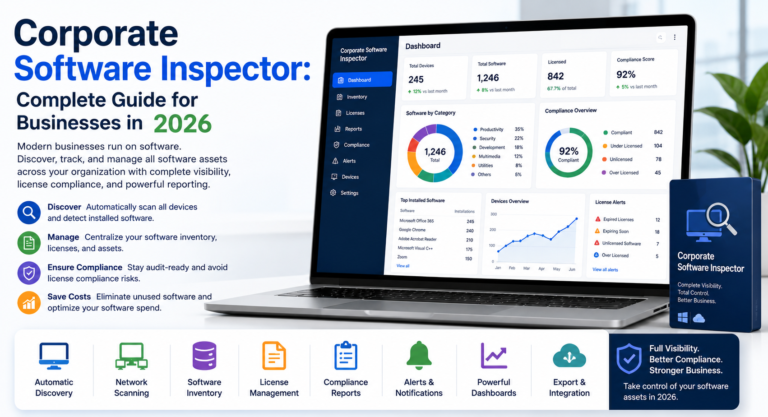
May you like: Corporate Software Inspector: Complete Guide for Businesses in 2026
Frequently Asked Questions
What is predictive maintenance software?
Predictive maintenance software uses sensor data, artificial intelligence, and analytics to identify potential equipment failures before they occur, allowing maintenance teams to schedule repairs proactively.
How is predictive maintenance different from preventive maintenance?
Preventive maintenance follows fixed schedules based on time or usage, while predictive maintenance uses real-time equipment condition data to determine when maintenance is actually needed.
Which industries benefit the most from predictive maintenance?
Manufacturing, energy, utilities, transportation, logistics, oil and gas, mining, food processing, pharmaceuticals, and large commercial facilities all benefit from predictive maintenance because equipment reliability directly impacts operations.
Is predictive maintenance software suitable for small businesses?
Yes. Many cloud-based solutions are designed for small and mid-sized organizations and can be scaled as operations grow. Starting with critical assets allows smaller businesses to realize value without significant upfront investment.
How long does implementation take?
Implementation timelines vary based on the number of assets, sensor installation requirements, integrations, and organizational readiness. Smaller deployments may take a few weeks, while enterprise-wide projects can take several months.
Conclusion
Modern organizations can no longer rely solely on reactive repairs or rigid maintenance schedules. Predictive maintenance software enables businesses to make informed, data-driven decisions that improve equipment reliability, reduce downtime, and optimize maintenance spending.
Whether you manage a manufacturing facility, utility network, logistics operation, or industrial plant, the right platform can provide valuable insights into asset health and help prevent costly failures before they disrupt operations.
When comparing vendors—including specialized providers such as Pulsar Industrial IoT Predictive Maintenance Software Company—look beyond feature lists. Evaluate integration capabilities, AI analytics, scalability, security, customer support, and long-term return on investment. A solution that fits your operational goals today should also support future growth and evolving maintenance strategies.
Next Step: Create a shortlist of predictive maintenance platforms, request product demonstrations, and identify a small group of critical assets for a pilot implementation. You may also benefit from exploring related guides on Enterprise Asset Management (EAM), CMMS software, Industrial IoT platforms, manufacturing software, and asset performance management to build a connected maintenance ecosystem.

For anyone who needs a reliable option, 125win is worth your time but make sure you understand what your doing before jumping in. The layout is pretty intuitive so its not hard to figure out. 125win login