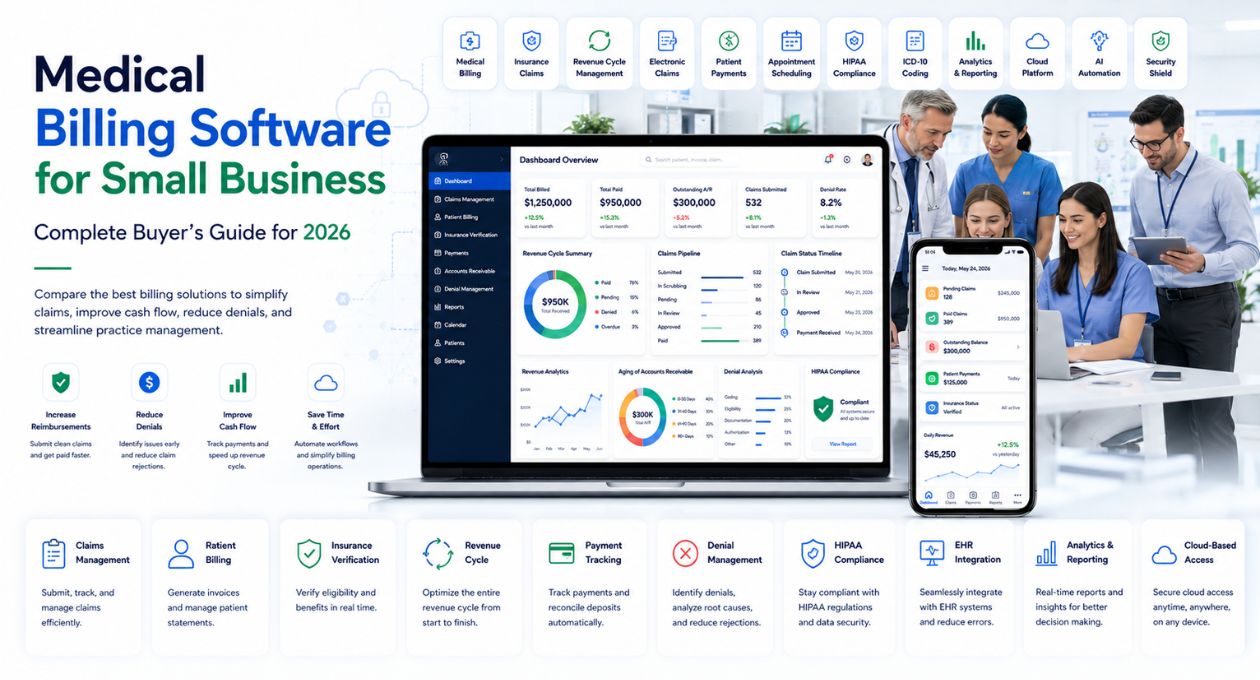
Medical Billing Software for Small Business: Complete Buyer’s Guide for 2026
Running a small healthcare practice is about much more than providing quality patient care. Physicians, dentists, chiropractors, therapists, and other healthcare professionals also need to manage insurance claims, patient billing, payment collections, coding accuracy, and regulatory compliance. When these administrative tasks become inefficient, they can slow cash flow, increase claim denials, and create unnecessary stress for staff.
Many small practices still rely on spreadsheets or outdated billing systems that require significant manual work. As patient volumes grow, these methods become difficult to manage and increase the likelihood of billing errors.
That’s why many providers are investing in medical billing software for small business.
Modern billing platforms automate repetitive tasks, simplify insurance claim submission, improve revenue cycle management (RCM), and help practices get paid faster. Many solutions also integrate with electronic health records (EHR), appointment scheduling, patient portals, and accounting software, reducing duplicate data entry and improving operational efficiency.
In this guide, you’ll learn:
- What medical billing software is
- Why small healthcare businesses need it
- The most important features to look for
- How to compare different solutions
- Common pricing models
- How to choose the best medical billing software for your practice
Whether you operate a private clinic, specialty practice, dental office, behavioral health center, or other healthcare business in the United States, this guide will help you make an informed software decision.
What Is Medical Billing Software?
Medical billing software is a digital solution that helps healthcare providers create, submit, track, and manage medical claims submitted to insurance companies while also handling patient billing and payment collection.
Instead of processing claims manually, the software automates much of the billing workflow, helping reduce errors and improve reimbursement speed.
Most medical billing systems support:
- Patient registration
- Insurance verification
- Medical coding
- Claim creation
- Electronic claim submission
- Payment posting
- Denial management
- Patient statements
- Financial reporting
Many modern platforms are cloud-based, allowing staff to access billing information securely from virtually anywhere with an internet connection.
Why Small Healthcare Businesses Need Medical Billing Software
Small practices often operate with limited administrative staff. A single employee may handle scheduling, insurance verification, billing, and patient communication.
Without automation, billing becomes time-consuming and prone to mistakes.
Medical billing software helps small businesses by simplifying everyday administrative tasks while improving financial performance.
Faster Insurance Claims
Manual claim preparation increases the likelihood of missing information or coding errors.
Billing software automatically validates claims before submission, reducing avoidable rejections.
Faster claim processing often leads to quicker reimbursements.
Reduced Administrative Work
Automation allows staff to spend less time on repetitive paperwork.
Examples include:
- Claim generation
- Payment reminders
- Eligibility verification
- Invoice creation
- Payment posting
Reducing manual work gives staff more time to focus on patient service.
Improved Cash Flow
Delayed payments create financial pressure for many small healthcare providers.
Medical billing software improves cash flow by helping practices:
- Submit claims faster
- Track outstanding balances
- Follow up on unpaid claims
- Send automated patient payment reminders
More efficient billing often results in more predictable revenue.
Better Accuracy
Medical billing errors can result in claim denials or payment delays.
Software helps improve accuracy by supporting:
- Coding validation
- Required field verification
- Duplicate claim detection
- Electronic claim editing
This reduces costly mistakes while improving reimbursement rates.
Enhanced Compliance
Healthcare organizations in the United States must protect patient information while complying with billing regulations.
Many billing platforms include features that support:
- HIPAA security requirements
- Audit trails
- Secure user authentication
- Role-based permissions
- Data encryption
Although software alone does not guarantee compliance, it provides tools that support secure billing practices.
Benefits of Medical Billing Software for Small Business
Investing in billing software provides advantages beyond claims processing.
Increased Revenue Collection
Faster claim submission and better denial management help practices receive payments more efficiently.
Many platforms also identify unpaid invoices and automate follow-up reminders.
Better Patient Experience
Patients increasingly expect convenient digital billing options.
Modern software often supports:
- Online payments
- Digital invoices
- Payment plans
- Patient portals
- Email reminders
Providing flexible payment options can improve patient satisfaction while reducing collection delays.
Simplified Reporting
Practice owners need visibility into financial performance.
Billing software provides reports covering:
- Revenue trends
- Outstanding claims
- Collection rates
- Insurance reimbursements
- Patient balances
- Payment aging
These insights help identify opportunities to improve financial performance.
Supports Practice Growth
As patient numbers increase, manual billing processes become increasingly difficult to manage.
Cloud-based billing systems allow practices to scale without dramatically increasing administrative workload.
Essential Features to Look For
Not every billing platform offers the same capabilities.
Choosing software with the right features depends on your specialty, patient volume, and workflow.
Electronic Claim Submission
Electronic claims are generally processed faster than paper claims.
Look for software that supports direct electronic claim submission to major insurance payers.
Insurance Eligibility Verification
Real-time insurance verification helps reduce rejected claims caused by inactive or incorrect coverage information.
Automating eligibility checks also improves front-office efficiency.
Medical Coding Support
Coding tools help staff assign accurate diagnosis and procedure codes.
Some systems also include coding suggestions or claim validation features to reduce errors before submission.
Denial Management
Claim denials affect revenue and increase administrative work.
Good billing software provides tools to:
- Track denied claims
- Identify denial reasons
- Manage appeals
- Monitor reimbursement trends
Effective denial management can significantly improve revenue collection.
Payment Processing
Integrated payment processing allows practices to accept:
- Credit cards
- Debit cards
- ACH transfers
- Online patient payments
Offering multiple payment methods improves patient convenience.
Patient Portal
Patient portals allow individuals to:
- View balances
- Make payments
- Download invoices
- Update insurance information
- Review billing history
Self-service features reduce incoming billing calls while improving patient engagement.
Reporting and Analytics
Comprehensive reporting helps practice owners monitor:
- Claim acceptance rates
- Revenue cycle performance
- Outstanding balances
- Payment trends
- Practice profitability
Real-time dashboards support better financial decision-making.
EHR Integration
Many providers already use Electronic Health Record (EHR) software.
Integration between billing and EHR systems reduces duplicate data entry and improves workflow efficiency.
When evaluating software, confirm compatibility with your existing clinical systems.
Who Should Use Medical Billing Software?
Medical billing software is valuable for a wide range of healthcare providers.
Independent Medical Practices
Small physician offices benefit from automated billing, faster claims processing, and improved financial reporting.
Dental Clinics
Dental practices can manage insurance claims, patient payments, treatment plans, and financial reporting more efficiently.
Behavioral Health Providers
Therapists, psychologists, and counseling practices often require specialized billing workflows and insurance management.
Chiropractic Clinics
Chiropractors can streamline coding, billing, and reimbursement while reducing paperwork.
Physical Therapy Practices
Therapy clinics often manage recurring appointments and insurance claims that benefit from automated billing workflows.
Urgent Care Centers
Urgent care providers process high patient volumes and benefit from faster insurance verification and claim submission.
How to Choose the Best Medical Billing Software for Small Business
Every practice has different operational needs, so selecting the right software requires careful evaluation.
Consider Your Practice Size
Some platforms are designed for solo practitioners, while others support multi-location healthcare organizations.
Choose software that matches both your current needs and future growth plans.
Review Integration Options
Your billing software should integrate with existing systems such as:
- Electronic Health Records (EHR)
- Appointment scheduling software
- Accounting software
- Payment gateways
- Laboratory systems
Strong integrations reduce manual work and improve data accuracy.
Evaluate Ease of Use
Billing software should simplify workflows rather than complicate them.
During product demonstrations or free trials, pay attention to:
- Navigation
- Dashboard layout
- Reporting tools
- Claim submission workflow
- Mobile accessibility
An intuitive interface can reduce training time and improve staff productivity.
Compare Customer Support
Reliable customer support is essential, especially during implementation.
Look for vendors that provide:
- Phone support
- Live chat
- Email assistance
- Knowledge bases
- Video tutorials
- Onboarding services
Responsive support can significantly reduce downtime when issues arise.
Understand Pricing
Medical billing software pricing varies depending on:
- Number of users
- Claim volume
- Cloud or on-premises deployment
- Included features
- Implementation services
- Support plans
Rather than choosing the lowest-priced option, evaluate the total value the software provides over time.
Internal Linking Opportunity: Link to related guides such as Electronic Health Record (EHR) Software, Medical Practice Management Software, Healthcare Revenue Cycle Management, Medical Scheduling Software, or Healthcare CRM Software.
Best Medical Billing Software for Small Business in 2026
The ideal billing solution depends on your practice size, specialty, budget, and existing technology. Some platforms are built for independent providers, while others offer advanced revenue cycle management for growing healthcare organizations.
Below are some of the most widely used medical billing solutions for small businesses.
1. Kareo Billing (Tebra)
Best for: Independent practices and small medical offices
Kareo, now part of Tebra, is designed specifically for independent healthcare providers. It combines medical billing, practice management, scheduling, and patient engagement tools in a cloud-based platform.
Key features:
- Electronic claim submission
- Insurance eligibility verification
- Appointment scheduling
- Patient payment tools
- Revenue cycle reporting
Pros
- Easy to learn
- Designed for smaller practices
- Strong customer support
- Cloud-based access
Considerations
- Advanced customization may be limited for larger organizations.
2. AdvancedMD
Best for: Growing practices with multiple providers
AdvancedMD offers an integrated platform that combines EHR, billing, scheduling, telehealth, and practice management.
Key features:
- Automated claim management
- Revenue cycle analytics
- Patient portal
- Telemedicine integration
- Mobile accessibility
Pros
- Comprehensive feature set
- Scalable platform
- Excellent reporting
Considerations
- May require more implementation time than simpler solutions.
3. athenaOne
Best for: Practices seeking AI-assisted revenue cycle management
athenaOne combines medical billing, EHR, patient engagement, and analytics into a single cloud platform.
Key features:
- Automated claim scrubbing
- Real-time payer updates
- Patient communication tools
- Revenue performance dashboards
Pros
- Strong automation
- Excellent payer connectivity
- Continuous platform updates
Considerations
- Pricing may be higher than some entry-level solutions.
4. DrChrono
Best for: Mobile-first healthcare practices
DrChrono is popular among small and mid-sized practices because of its intuitive interface and mobile capabilities.
Key features:
- Medical billing
- EHR integration
- Scheduling
- Patient portal
- Electronic prescribing
Pros
- Easy mobile access
- User-friendly interface
- Flexible customization
Considerations
- Some advanced reporting features may require higher-tier plans.
5. CareCloud
Best for: Practices focused on revenue cycle optimization
CareCloud offers billing, practice management, analytics, and patient experience tools designed to improve financial performance.
Key features:
- Automated billing workflows
- Denial management
- Financial reporting
- Insurance verification
- Revenue cycle management
Pros
- Strong billing automation
- Good reporting capabilities
- Scalable architecture
Considerations
- Implementation may take longer for complex practices.
How Much Does Medical Billing Software Cost?
Pricing varies depending on the vendor, practice size, features, and billing model.
Common pricing structures include:
- Monthly subscription per provider
- Per-user pricing
- Percentage of collections
- Custom enterprise pricing
Typical costs are:
| Practice Size | Estimated Monthly Cost |
| Solo provider | $100–$400 |
| Small practice (2–10 providers) | $400–$2,000 |
| Growing or multi-location practice | Custom pricing |
Some vendors also charge separate fees for:
- Data migration
- Staff training
- Implementation
- Premium support
- Additional integrations
When comparing solutions, consider the total cost of ownership, including software, onboarding, maintenance, and future scalability.
Best Practices for Implementing Medical Billing Software
Even the best software requires careful implementation to deliver measurable results.
Map Your Existing Billing Workflow
Before switching systems, document how your current billing process works.
Identify:
- Common bottlenecks
- Frequent claim denials
- Manual tasks
- Reporting needs
- Compliance requirements
Understanding your existing workflow helps ensure the new software addresses real operational challenges.
Clean and Migrate Data Carefully
Accurate data migration is essential.
Before importing records:
- Verify patient demographics
- Update insurance information
- Remove duplicate records
- Review outstanding claims
- Confirm provider details
Clean data reduces billing errors after deployment.
Train Your Team
Provide role-based training for:
- Front-desk staff
- Billing specialists
- Office managers
- Providers
- Administrators
Well-trained employees are more likely to use advanced features and avoid costly mistakes.
Monitor Performance After Launch
Track key performance indicators (KPIs) such as:
- First-pass claim acceptance rate
- Average reimbursement time
- Claim denial rate
- Days in accounts receivable (A/R)
- Patient payment collection rate
Monitoring these metrics helps identify opportunities for continuous improvement.
Common Mistakes to Avoid
Choosing billing software is a long-term investment. Avoiding common mistakes can save time and money.
Choosing Software Based Only on Price
Lower-cost software may lack essential features such as EHR integration, reporting, or denial management.
Focus on value rather than the lowest subscription fee.
Ignoring Integration Requirements
Disconnected systems create duplicate work and increase the risk of errors.
Confirm compatibility with your:
- EHR system
- Practice management software
- Accounting platform
- Payment processor
- Laboratory systems
Overlooking Compliance
Healthcare billing involves sensitive patient information.
Choose software that supports:
- HIPAA security requirements
- Data encryption
- Role-based permissions
- Audit logs
- Secure backups
Skipping Staff Training
Even intuitive software requires onboarding.
Without proper training, employees may develop inefficient workflows or misuse important features.
Not Planning for Growth
As your practice expands, your billing software should support additional providers, locations, and patient volume without requiring a complete replacement.
Future Trends in Medical Billing Software
Healthcare billing technology continues to evolve rapidly.
Artificial Intelligence
AI is increasingly used to:
- Detect coding errors
- Predict claim denials
- Automate claim reviews
- Improve revenue forecasting
Cloud-Based Revenue Cycle Management
Cloud platforms provide easier updates, remote access, and improved scalability for growing practices.
Automation
Routine administrative tasks such as eligibility verification, payment reminders, and claim tracking continue to become more automated.
Better Patient Payment Experiences
Patients increasingly expect digital payment options including:
- Online billing portals
- Mobile payments
- Automated reminders
- Flexible payment plans
Practices that simplify the payment experience often see faster collections and improved patient satisfaction.
Frequently Asked Questions
What is the best medical billing software for small business?
The best choice depends on your specialty, budget, and workflow. Popular options include Kareo (Tebra), AdvancedMD, athenaOne, DrChrono, and CareCloud because they combine billing automation with practice management and reporting features.
How much does medical billing software cost?
Most small practices can expect monthly costs ranging from approximately $100 to $2,000, depending on the number of providers, features, and pricing model.
Can medical billing software integrate with EHR systems?
Yes. Most modern solutions integrate with Electronic Health Record (EHR) platforms, helping reduce duplicate data entry and improve workflow efficiency.
Is cloud-based medical billing software secure?
Reputable cloud providers use encryption, access controls, secure hosting, and audit logging to help protect patient information. Practices should still follow HIPAA policies and internal security procedures.
Do small practices really need medical billing software?
Yes. Even solo providers can benefit from faster claim submission, fewer billing errors, improved cash flow, and better financial reporting.
May you like: Corporate Software Inspector: Complete Guide for Businesses in 2026
Conclusion
Selecting the right medical billing software for small business is one of the most important technology decisions a healthcare practice can make. A reliable billing platform not only simplifies insurance claims and patient payments but also improves cash flow, reduces administrative workload, and supports long-term practice growth.
When evaluating solutions, look beyond marketing claims. Consider ease of use, EHR integration, reporting capabilities, customer support, scalability, security, and total cost of ownership. The best medical billing software for small business is the one that aligns with your specialty, patient volume, billing workflow, and future goals.
Before making a final decision, create a shortlist of vendors, request live demonstrations, and involve both administrative and clinical staff in the evaluation process. You may also find it useful to explore related guides on Electronic Health Record (EHR) software, medical practice management software, healthcare revenue cycle management, or medical scheduling software to build a fully integrated technology ecosystem for your practice.