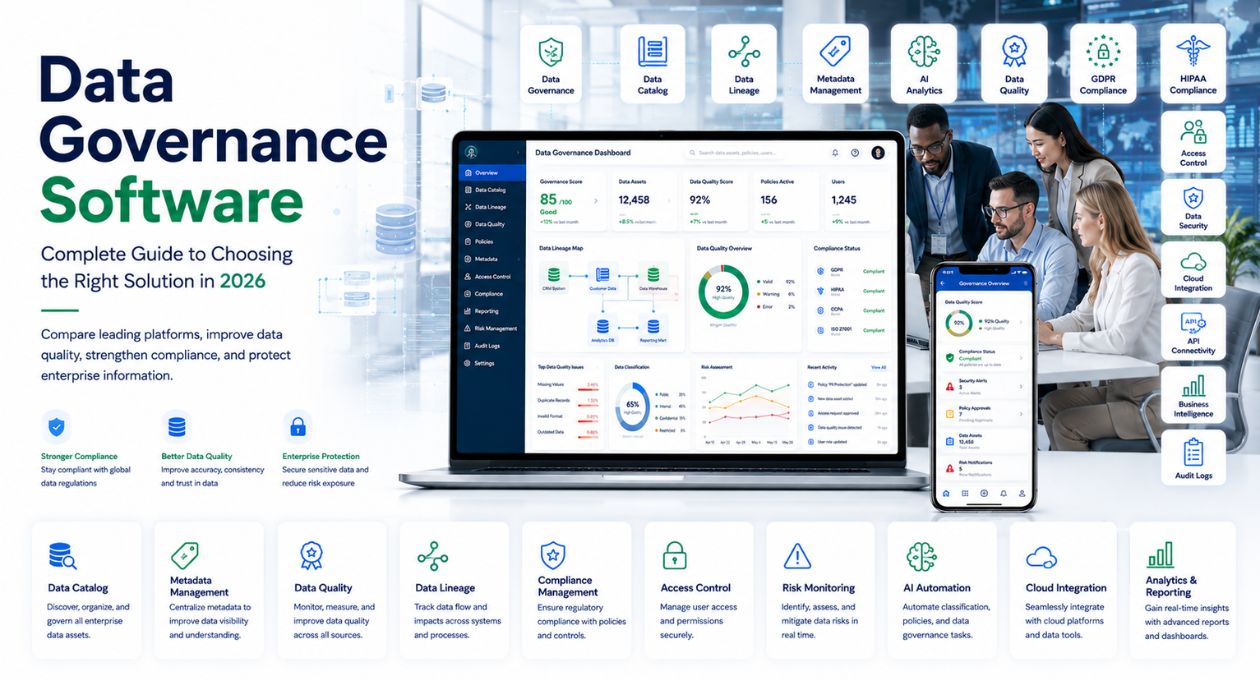
Data Governance Software: Complete Guide to Choosing the Right Solution in 2026
Data has become one of the most valuable assets for modern organizations. Every customer interaction, sales transaction, employee record, and business decision generates information that can drive growth—or create serious risks if it isn’t managed properly.
Many organizations collect enormous amounts of data but struggle to answer simple questions:
- Where is our sensitive data stored?
- Who has access to it?
- Is the information accurate and up to date?
- Are we meeting compliance requirements?
- Can employees trust the data they’re using?
Without clear governance, data quickly becomes inconsistent, duplicated, outdated, or exposed to unauthorized users. These problems can affect decision-making, increase security risks, and lead to costly regulatory violations.
This is where data governance software plays a critical role.
Instead of relying on manual spreadsheets, disconnected tools, or undocumented processes, data governance platforms help organizations establish policies, improve data quality, manage metadata, control access, and maintain compliance across the entire data lifecycle.
In this guide, you’ll learn:
- What data governance software is
- Why businesses are investing in governance platforms
- The difference between governance and data access governance
- Essential features to look for
- Benefits for organizations of all sizes
- How to evaluate the right solution for your business
Whether you’re an IT leader, data manager, compliance officer, or business executive in the United States, this guide will help you understand how modern data governance solutions support better decision-making and stronger data security.
What Is Data Governance Software?
Data governance software is a platform that helps organizations manage, protect, organize, and control their data according to established business rules, security policies, and regulatory requirements.
Rather than storing data itself, governance software provides the framework for managing how data is created, classified, accessed, shared, and maintained across an organization.
A typical data governance platform helps organizations:
- Create data policies
- Define ownership and responsibilities
- Improve data quality
- Track metadata
- Manage data lineage
- Control user access
- Monitor compliance
- Audit data usage
The ultimate goal is to ensure that business users can trust the information they rely on while reducing security and compliance risks.
What Is Data Access Governance Software?
Although the terms are often used interchangeably, data governance software and data access governance software solve different problems.
Data governance software focuses on the overall management of enterprise data, including policies, quality, metadata, stewardship, and compliance.
Data access governance software specifically manages who can access data, when they can access it, and what actions they are allowed to perform.
It helps organizations:
- Discover sensitive information
- Identify excessive permissions
- Enforce least-privilege access
- Monitor user activity
- Review access rights
- Detect unusual behavior
- Reduce insider security risks
Many modern governance platforms now include access governance capabilities, allowing organizations to manage both data quality and security from a single solution.
Why Data Governance Matters More Than Ever
Organizations today generate data from dozens of different sources, including:
- Customer relationship management (CRM) systems
- Enterprise resource planning (ERP) software
- Marketing platforms
- Cloud storage
- Business intelligence tools
- IoT devices
- Mobile applications
- Artificial intelligence systems
As the volume of information grows, managing it manually becomes almost impossible.
Poor governance often leads to:
- Duplicate records
- Inconsistent reporting
- Security vulnerabilities
- Compliance failures
- Data silos
- Poor business decisions
- Increased operational costs
A strong governance strategy creates consistent standards that improve the reliability and security of enterprise data.
Key Benefits of Data Governance Software
Organizations invest in governance platforms for many reasons beyond regulatory compliance.
Improves Data Quality
Reliable business decisions depend on reliable data.
Governance software helps identify:
- Duplicate records
- Missing values
- Incorrect information
- Inconsistent formatting
- Outdated records
Improving data quality increases confidence in reports, dashboards, and analytics.
Strengthens Data Security
Sensitive information should only be accessible to authorized users.
Governance platforms help organizations:
- Classify confidential data
- Monitor access
- Detect unusual activity
- Reduce unnecessary permissions
- Support zero-trust security models
These capabilities reduce the likelihood of accidental exposure or unauthorized access.
Supports Regulatory Compliance
Organizations operating in the United States may need to comply with regulations such as:
- HIPAA (Healthcare)
- CCPA and CPRA (California consumer privacy)
- SOX (Financial reporting)
- GLBA (Financial institutions)
Businesses operating internationally may also need to support GDPR and other global privacy frameworks.
Data governance software helps maintain audit trails, document policies, and demonstrate compliance during regulatory reviews.
Improves Business Decision-Making
Executives rely on accurate information when making strategic decisions.
Governance platforms improve confidence by ensuring that reports are based on trusted, consistent, and verified data.
Instead of debating which numbers are correct, teams can focus on analyzing business performance.
Increases Operational Efficiency
Employees often spend valuable time searching for data or verifying whether information is accurate.
Governance software makes data easier to discover by providing:
- Metadata catalogs
- Business glossaries
- Search capabilities
- Data lineage visualization
This reduces duplication of effort and improves collaboration across departments.
Essential Features to Look For
Choosing the right platform requires understanding which capabilities matter most for your organization.
Data Catalog
A centralized data catalog helps users discover available datasets across the organization.
It typically includes:
- Data descriptions
- Ownership information
- Usage history
- Business definitions
- Tags and classifications
A well-maintained catalog reduces confusion and improves data accessibility.
Metadata Management
Metadata describes the data itself.
Governance software helps organizations maintain consistent metadata so users understand:
- Where data originates
- How it has changed
- Who owns it
- How it should be used
This improves transparency throughout the organization.
Data Lineage
Data lineage shows how information moves from its original source through different systems.
This visibility helps teams:
- Troubleshoot reporting issues
- Understand data transformations
- Support compliance audits
- Improve trust in analytics
Lineage diagrams are especially valuable for complex enterprise environments.
Policy Management
Organizations should be able to create and enforce governance policies from a central location.
Examples include:
- Data retention rules
- Classification standards
- Privacy requirements
- Quality thresholds
- Access policies
Centralized policy management improves consistency across departments.
Data Quality Monitoring
Automated quality monitoring continuously checks datasets for issues such as:
- Missing values
- Duplicate records
- Invalid formats
- Incomplete information
- Unexpected changes
Alerts help teams resolve problems before they affect business operations.
Workflow Automation
Manual governance processes rarely scale.
Automation supports:
- Data approval workflows
- Stewardship assignments
- Issue tracking
- Quality reviews
- Compliance documentation
This reduces administrative work while improving accountability.
Role-Based Access Control
Access should be granted according to business responsibilities.
Role-based controls help organizations:
- Limit unnecessary permissions
- Reduce insider risks
- Simplify administration
- Support compliance requirements
This is one of the most important features for organizations managing sensitive customer or employee information.
Who Needs Data Governance Software?
Although large enterprises often lead governance initiatives, organizations of all sizes benefit from structured data management.
Healthcare
Healthcare organizations manage protected patient information that requires strict privacy controls.
Governance software supports accurate records, secure access, and regulatory compliance while improving care coordination.
Financial Services
Banks, insurance companies, and investment firms process highly sensitive financial data.
Governance platforms improve audit readiness, reduce operational risk, and support regulatory reporting.
Retail and E-commerce
Retail businesses collect customer profiles, payment information, inventory data, and marketing analytics.
Good governance improves personalization while helping protect customer information.
Manufacturing
Manufacturers rely on data from production systems, suppliers, quality control processes, and connected equipment.
Governance ensures that operational data remains accurate and accessible across the supply chain.
Government and Public Sector
Government agencies handle large volumes of confidential information and often operate under strict compliance requirements.
Governance software improves transparency, accountability, and data security.
How to Choose the Right Data Governance Software
Selecting the right platform involves more than comparing feature lists.
Ask these questions during your evaluation process.
What Business Problems Are You Trying to Solve?
Some organizations prioritize regulatory compliance, while others focus on improving analytics or securing sensitive information.
Clearly defining your goals helps narrow the list of potential vendors.
Can the Platform Scale?
Your data environment will continue to grow.
Choose software that supports additional users, datasets, cloud environments, and future integrations without requiring major redesigns.
Does It Integrate With Existing Systems?
Look for compatibility with your current technology stack, including:
- Cloud platforms
- Data warehouses
- Business intelligence tools
- Identity providers
- CRM systems
- ERP applications
Strong integrations reduce manual work and improve adoption.
Is the Interface Easy to Use?
Governance software should support both technical teams and business users.
Look for intuitive dashboards, searchable catalogs, and simple workflows that encourage organization-wide adoption.
Internal Linking Opportunity: Link to related guides such as Data Management Software, Master Data Management (MDM), Data Security Software, Cloud Data Integration, or Business Intelligence Tools.
Best Data Governance Software in 2026
The right data governance platform depends on your organization’s size, industry, compliance requirements, and existing technology stack. Some solutions focus on enterprise-scale governance, while others prioritize data quality, metadata management, or data access governance.
Below are some of the leading platforms businesses frequently evaluate in 2026.
1. Microsoft Purview
Best for: Organizations using Microsoft Azure and Microsoft 365
Microsoft Purview offers a unified approach to data governance across on-premises, multi-cloud, and SaaS environments. It combines data discovery, classification, cataloging, lineage, and compliance tools within a single platform.
Key features:
- Automated data discovery
- Sensitive data classification
- Data catalog and lineage
- Compliance management
- Access policy management
2. Informatica Intelligent Data Management Cloud
Best for: Large enterprises with complex data ecosystems
Informatica is widely recognized for its enterprise-grade data governance capabilities. It provides robust metadata management, data quality monitoring, master data management (MDM), and AI-assisted automation.
Key features:
- Enterprise data catalog
- AI-powered metadata discovery
- Data quality monitoring
- Data stewardship workflows
- Master data management integration
3. Collibra
Best for: Organizations focused on business-friendly data governance
Collibra emphasizes collaboration between business users and technical teams. Its intuitive interface makes it easier for employees to discover trusted data assets and understand ownership, policies, and definitions.
Key features:
- Business glossary
- Data catalog
- Policy management
- Workflow automation
- Data lineage visualization
4. Alation
Best for: Data-driven organizations that prioritize analytics
Alation combines a modern data catalog with governance capabilities, helping teams quickly discover trusted datasets while maintaining strong governance controls.
Key features:
- Intelligent search
- Metadata management
- Data stewardship
- Usage analytics
- Collaboration tools
5. OneTrust Data Governance
Best for: Privacy and regulatory compliance
OneTrust integrates privacy management, governance, and compliance into a single platform. It is particularly valuable for organizations managing large volumes of personal information across multiple jurisdictions.
Key features:
- Privacy assessments
- Regulatory compliance support
- Data inventory
- Risk management
- Consent management integration
Choosing Between Governance and Access Governance Solutions
Some organizations only need metadata management and policy enforcement, while others require advanced permission management and identity governance.
If your biggest challenge involves questions like:
- Who has access to sensitive files?
- Are permissions appropriate?
- Can we automatically review access rights?
Then a platform with strong data access governance software capabilities should be part of your evaluation criteria.
How Much Does Data Governance Software Cost?
There is no standard pricing model because governance platforms vary widely in functionality and deployment size.
Pricing is typically influenced by:
- Number of users
- Data volume
- Cloud or on-premises deployment
- Number of connected data sources
- AI and automation features
- Support and professional services
- Compliance requirements
General pricing estimates include:
| Organization Size | Estimated Cost |
| Small business | $5,000–$20,000 annually |
| Mid-sized organization | $20,000–$100,000 annually |
| Enterprise | Custom pricing, often exceeding $100,000 annually |
Implementation, training, integration, and ongoing maintenance should also be included when calculating the total cost of ownership.
Best Practices for Implementing Data Governance Software
Technology alone cannot solve governance challenges. Success depends on combining the right platform with clear processes, executive support, and organizational commitment.
Define Clear Governance Objectives
Before selecting software, identify what success looks like.
For example:
- Improve reporting accuracy
- Meet regulatory requirements
- Reduce duplicate records
- Strengthen security
- Increase trust in business data
Clear goals make implementation more focused and measurable.
Assign Data Owners and Stewards
Every important dataset should have defined ownership.
Data owners establish governance policies, while data stewards oversee day-to-day data quality, documentation, and issue resolution.
Clearly assigned responsibilities improve accountability across the organization.
Start With High-Value Data
Trying to govern every dataset at once often slows projects.
Instead, begin with business-critical information such as:
- Customer records
- Financial data
- Employee information
- Healthcare records
- Product data
Early success builds momentum for broader governance initiatives.
Establish Consistent Data Standards
Standardize naming conventions, metadata definitions, quality rules, and classification policies across departments.
Consistency improves collaboration and reduces confusion when multiple teams work with the same information.
Train Employees
Governance is not just an IT initiative.
Employees across HR, finance, marketing, operations, and customer service should understand:
- Why governance matters
- Their responsibilities
- How to use governance tools
- Data security best practices
Regular training encourages long-term adoption.
Common Mistakes to Avoid
Many governance projects fail because organizations focus on technology while overlooking people and processes.
Avoid these common mistakes.
Treating Governance as an IT Project Only
Successful governance requires collaboration between business leaders, compliance teams, security professionals, and data users.
Business ownership is just as important as technical implementation.
Ignoring Data Quality
Even the best governance platform cannot produce reliable insights if the underlying data is inaccurate.
Prioritize data cleansing before expanding governance initiatives.
Creating Overly Complex Policies
Governance policies should be practical and easy to understand.
Complicated rules often reduce adoption and encourage workarounds.
Failing to Monitor Progress
Governance is an ongoing process.
Track metrics such as:
- Data quality scores
- Policy compliance
- Access review completion
- Duplicate record reduction
- Metadata completeness
Continuous monitoring helps identify areas for improvement.
Overlooking Change Management
Employees may resist new processes if they don’t understand the benefits.
Communicate how governance improves productivity, reduces risk, and supports better decision-making.
Future Trends in Data Governance Software
The data landscape continues to evolve, and governance platforms are becoming more intelligent and automated.
Artificial Intelligence for Governance
AI now assists with:
- Automatic data classification
- Metadata generation
- Anomaly detection
- Policy recommendations
- Data quality monitoring
These capabilities reduce manual effort while improving consistency.
Data Fabric Architecture
Data fabric connects information across multiple environments, allowing organizations to apply governance policies consistently across cloud, hybrid, and on-premises systems.
Data Mesh
Large organizations are increasingly adopting data mesh principles, giving business domains greater ownership of their data while maintaining centralized governance standards.
Automated Compliance Monitoring
Future governance platforms will continue expanding automated compliance features that monitor regulatory requirements and generate audit-ready reports with minimal manual intervention.
Unified Data Access Governance
Organizations increasingly prefer platforms that combine governance, identity management, and data access governance within a single solution, reducing administrative complexity and improving visibility.
Frequently Asked Questions
What is data governance software?
Data governance software helps organizations manage data quality, security, policies, metadata, ownership, and compliance. It provides a structured framework for ensuring that business data remains accurate, secure, and trustworthy.
What is the difference between data governance software and data access governance software?
Data governance software manages the overall lifecycle of organizational data, including quality, metadata, and compliance. Data access governance software focuses specifically on controlling, monitoring, and auditing who can access sensitive information.
Who should use data governance software?
Organizations of all sizes can benefit, particularly those operating in regulated industries such as healthcare, finance, government, insurance, manufacturing, and retail.
How long does a data governance implementation take?
Implementation timelines vary based on organization size and complexity. Smaller deployments may take several weeks, while enterprise-wide initiatives often require several months and ongoing refinement.
Can small businesses benefit from data governance software?
Yes. Even smaller organizations benefit from improved data quality, better security, and consistent business processes. Many cloud-based solutions are designed to scale as businesses grow.
May you like: Corporate Software Inspector: Complete Guide for Businesses in 2026
Conclusion
As organizations continue generating larger volumes of business data, managing that information effectively has become a strategic priority rather than just an IT responsibility. Data governance software provides the structure needed to improve data quality, strengthen security, support regulatory compliance, and build trust in the information employees rely on every day.
For businesses handling sensitive customer, financial, healthcare, or operational data, investing in governance is no longer optional. A well-implemented governance strategy reduces risk, improves collaboration, and enables better decision-making across every department.
When evaluating solutions, focus on more than feature lists. Consider scalability, ease of use, integration capabilities, automation, compliance support, and long-term value. If controlling permissions and protecting sensitive information is a top concern, prioritize platforms that also include strong data access governance software capabilities.
Next Step: Begin by assessing your current data environment, identifying governance gaps, and documenting your business objectives. Then compare leading platforms through product demonstrations or proof-of-concept projects. You may also want to explore related guides on Master Data Management (MDM), data security software, cloud data integration, or business intelligence platforms to build a comprehensive data management strategy.