How to Choose the Right Grant Management Software In 2026
Introduction
Managing grants sounds simple until applications start piling up, reporting deadlines arrive at the same time, and multiple stakeholders need access to the same information. Whether you’re a nonprofit applying for funding or a foundation distributing millions of dollars in grants, manual spreadsheets quickly become difficult to manage.
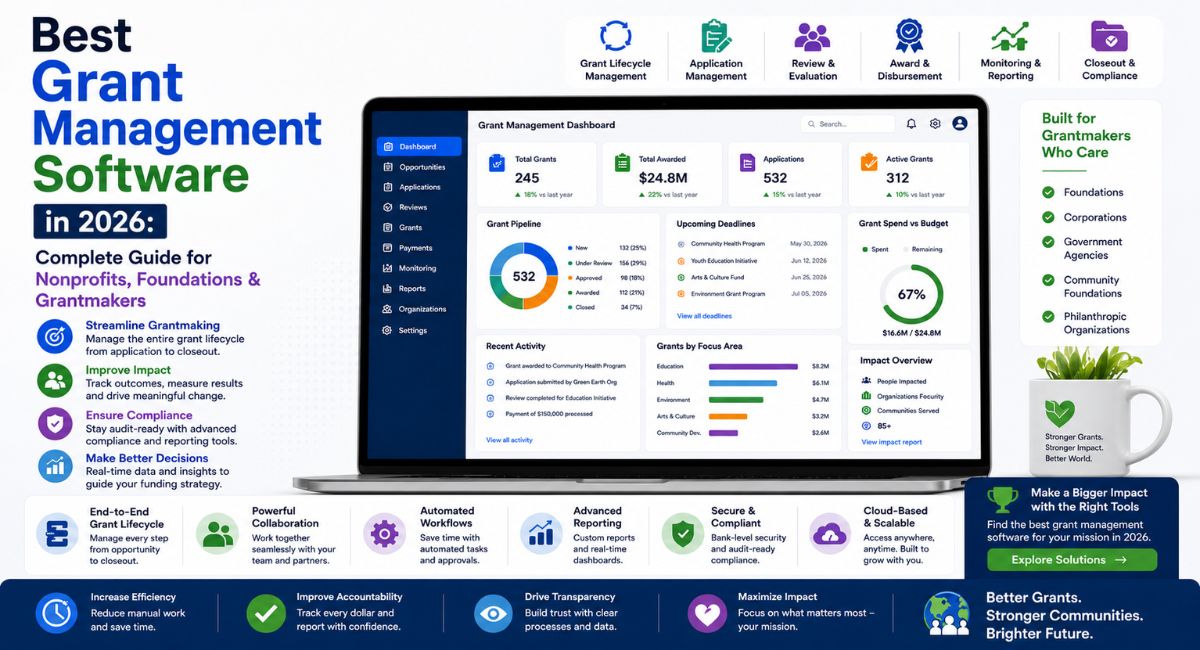
Grant management software helps organizations streamline the entire grant lifecycle—from discovering funding opportunities and collecting applications to reviewing proposals, distributing funds, tracking outcomes, and generating compliance reports. Instead of juggling emails, paper files, and disconnected systems, organizations can manage every stage from a centralized platform.
Modern grant management platforms also improve collaboration between applicants, reviewers, finance teams, and program managers. Many solutions now include workflow automation, AI-powered recommendations, customizable dashboards, and integrations with CRM and accounting software, making them valuable tools for organizations of every size.
In this guide, you’ll learn how grant management software works, which features matter most, how to compare leading platforms, and how to choose the right solution for your organization.
What Is Grant Management Software?
Definition and Purpose
Grant management software is a specialized platform that helps organizations manage the complete grant lifecycle. It provides tools for creating funding opportunities, accepting applications, reviewing submissions, awarding grants, tracking budgets, monitoring project progress, and generating compliance reports.
Instead of managing grants through spreadsheets, emails, and paper documents, organizations can centralize every process in one secure system. This improves visibility, reduces administrative work, and minimizes the risk of missing deadlines or compliance requirements.
Although many people associate grant management software with nonprofits, it also supports private foundations, government agencies, universities, healthcare organizations, research institutions, and corporate social responsibility (CSR) programs.
The primary goal is straightforward: simplify grant administration while improving transparency, accountability, and decision-making.
How Grant Management Software Works
Most grant management platforms follow a structured workflow that covers every stage of the grant process.
First, administrators create grant programs and define eligibility criteria, deadlines, required documents, scoring methods, and approval workflows.
Applicants then submit proposals through an online portal instead of sending documents by email. The software validates submissions, stores supporting files, and notifies applicants about their application status.
Reviewers evaluate applications using customizable scorecards and collaboration tools. Many platforms support blind reviews, weighted scoring, reviewer assignments, and automated notifications.
Once decisions are finalized, the software manages award letters, payment schedules, milestone tracking, financial reporting, and compliance documentation.
Throughout the grant period, organizations can monitor budgets, collect progress reports, evaluate project outcomes, and generate reports for leadership, auditors, or funding partners.
Many modern platforms also integrate with CRM systems, accounting software, document management tools, and business intelligence platforms to eliminate duplicate data entry.
Who Uses Grant Management Software?
Grant management software serves a wide range of organizations. Although their goals differ, they all share the need for efficient workflows, accurate reporting, and strong compliance controls.
Nonprofit Organizations
Nonprofits often manage multiple grants from government agencies, foundations, and corporate sponsors simultaneously. Grant management software helps them identify funding opportunities, submit applications, monitor reporting deadlines, track restricted funding, and demonstrate program impact.
Instead of maintaining separate spreadsheets for every grant, nonprofit teams gain a centralized system that improves collaboration and reduces administrative overhead.
Private Foundations
Private foundations distribute grants to charities, educational institutions, community organizations, and research programs. They typically receive hundreds—or even thousands—of applications for each funding cycle.
Grant management software simplifies application collection, reviewer assignments, scoring, approval workflows, payment tracking, and impact measurement. It also improves transparency by documenting every funding decision.
Government Agencies
Federal, state, and local government agencies often administer large grant programs with strict regulatory requirements.
Grant management software helps agencies enforce eligibility rules, monitor compliance, maintain detailed audit trails, and produce standardized reports. Workflow automation also reduces manual processing time while improving consistency across departments.
Because public funding requires strong accountability, secure recordkeeping and reporting features are especially important.
Educational Institutions
Universities, colleges, research institutes, and school districts rely on grants to support research projects, scholarships, innovation programs, and community initiatives.
Grant management platforms help institutions coordinate applications across multiple departments, manage budgets, monitor project milestones, and satisfy sponsor reporting requirements.
Researchers also benefit from centralized documentation, making future grant applications easier to prepare.
Corporate Giving Programs
Many businesses invest in philanthropy through corporate social responsibility (CSR) initiatives and employee giving programs.
Grant management software enables companies to accept funding requests, evaluate proposals, distribute grants, monitor community impact, and publish transparent reports for executives and stakeholders.
Some enterprise platforms also integrate with volunteer management, donation tracking, and ESG reporting systems, providing a broader view of corporate social impact.
Grant management continues to grow more complex as organizations handle larger funding portfolios, stricter compliance requirements, and higher expectations for transparency. A modern grant management platform reduces manual work, improves collaboration, and provides the visibility needed to manage funding programs with confidence.
In the next section, we’ll explore why grant management software has become an essential investment, the common challenges organizations face without it, and the measurable benefits these platforms deliver.
Why Grant Management Software Is Important
Grant management has evolved far beyond tracking applications in spreadsheets or storing documents in shared folders. Organizations now manage multiple funding sources, stricter compliance requirements, and growing reporting expectations. As grant portfolios expand, manual processes become difficult to maintain.
Grant management software provides a centralized system that improves efficiency, increases transparency, and helps organizations make informed funding decisions.
Common Challenges in Grant Management
Many organizations face similar obstacles regardless of their size.
Managing Large Volumes of Applications
Popular grant programs can receive hundreds or even thousands of applications within a short period. Reviewing every submission manually consumes valuable staff time and increases the chance of errors.
Tracking Multiple Deadlines
Every grant has its own application deadlines, review periods, reporting schedules, payment milestones, and compliance requirements. Missing a single deadline can delay funding or create regulatory issues.
Maintaining Accurate Financial Records
Grant managers need to monitor budgets, reimbursements, expenditures, and remaining balances throughout the funding lifecycle. Without centralized tracking, financial data often becomes fragmented across different systems.
Ensuring Regulatory Compliance
Government grants and foundation funding frequently require detailed documentation, audit trails, and standardized reporting. Manual recordkeeping makes compliance more difficult and increases administrative risk.
Improving Collaboration
Grant administration usually involves finance teams, reviewers, executives, applicants, and program managers. Without shared workflows, communication gaps slow decision-making and create duplicate work.
Benefits of Using Grant Management Software
Modern grant management platforms address these challenges while improving operational efficiency.
Faster Application Processing
Online portals automatically collect applications, validate required information, and organize submissions for reviewers. This reduces manual data entry and speeds up the evaluation process.
Better Collaboration
Centralized dashboards allow reviewers, finance teams, and administrators to access the same information in real time. Everyone works from a single source of truth instead of exchanging spreadsheets through email.
Improved Compliance
Most grant management systems maintain detailed audit logs, document histories, and approval records. These features simplify internal reviews and external audits.
Stronger Financial Oversight
Budget tracking tools help organizations monitor grant spending, payment schedules, remaining balances, and financial performance throughout the grant period.
Better Reporting
Instead of manually compiling reports, organizations can generate dashboards showing funding allocation, application status, program performance, and grant outcomes.
Increased Transparency
Applicants receive timely updates, reviewers follow standardized scoring processes, and decision-makers gain better visibility into funding activities.
Manual Grant Management vs Software
Many smaller organizations begin with spreadsheets because they are familiar and inexpensive. However, spreadsheets become difficult to maintain as grant programs grow.
| Manual Process | Grant Management Software |
| Separate spreadsheets | Centralized platform |
| Manual data entry | Automated workflows |
| Email-based communication | Built-in collaboration |
| Limited reporting | Interactive dashboards |
| Higher error risk | Automated validation |
| Difficult compliance tracking | Complete audit trails |
| Time-consuming reviews | Structured review workflows |
For organizations managing multiple grants each year, dedicated software usually delivers significant time savings while improving accuracy and accountability.
Key Features to Look for in Grant Management Software
Not every platform offers the same capabilities. The best solution depends on your organization’s size, funding programs, reporting requirements, and existing technology stack.
Below are the features that deserve the most attention during your evaluation.
Grant Application Management
An effective application management system should simplify both the applicant and administrator experience.
Look for software that supports:
- Online application portals
- Custom application forms
- Eligibility screening
- File uploads
- Automatic confirmation emails
- Deadline management
- Application status tracking
A smooth application process reduces incomplete submissions and improves the overall experience for applicants.
Grant Discovery and Prospecting
Some platforms also help organizations identify new funding opportunities.
These tools may include:
- Grant opportunity databases
- Funding alerts
- Keyword searches
- Deadline reminders
- Prospect tracking
- Saved funding lists
Grant discovery features are particularly valuable for nonprofits seeking new funding sources.
Workflow Automation
Automation removes repetitive administrative tasks and keeps grant programs moving efficiently.
Examples include:
- Automatic reviewer assignments
- Email notifications
- Approval routing
- Deadline reminders
- Payment scheduling
- Report requests
Automation not only saves time but also reduces the likelihood of missed tasks.
Application Review and Scoring
A structured review process promotes fairness and consistency.
Strong review tools typically offer:
- Custom scoring rubrics
- Reviewer comments
- Weighted evaluation criteria
- Blind review options
- Consensus scoring
- Approval workflows
These features help organizations make transparent and evidence-based funding decisions.
Budget and Financial Tracking
Financial oversight remains one of the most important aspects of grant administration.
A good platform should help monitor:
- Grant budgets
- Approved funding
- Payment schedules
- Expense tracking
- Remaining balances
- Financial reporting
Many enterprise platforms also integrate directly with accounting software to reduce duplicate data entry.
Compliance and Audit Management
Compliance requirements vary across government agencies, foundations, and corporate funding programs.
Look for software that provides:
- Audit trails
- Document history
- Version control
- Policy tracking
- Compliance reminders
- Secure record retention
These features simplify audits and reduce regulatory risk.
Reporting and Dashboards
Grant managers need quick access to meaningful insights.
Interactive dashboards often include:
- Application statistics
- Award distribution
- Budget utilization
- Reviewer progress
- Funding trends
- Program performance
- Compliance status
Custom reports also help executives make data-driven funding decisions.
Document Management
Every grant generates contracts, proposals, budgets, invoices, reports, and supporting documents.
Built-in document management should include:
- Secure storage
- Version control
- Search functionality
- Permission controls
- File organization
- Shared access
Keeping documents centralized reduces confusion and improves collaboration.
Collaboration Tools
Grant programs involve multiple stakeholders.
Effective collaboration features include:
- Shared workspaces
- Internal comments
- Reviewer discussions
- Task assignments
- Notification systems
- Role-based permissions
These capabilities keep projects moving without relying on lengthy email chains.
CRM Integration
Many nonprofits already manage donors, applicants, and partners through CRM platforms.
Integration with systems like Salesforce or Microsoft Dynamics helps synchronize contact information, funding history, and communication records automatically.
Accounting Software Integration
Financial accuracy improves when grant management software connects with accounting systems.
Common integrations include:
- QuickBooks
- Sage Intacct
- Microsoft Dynamics
- Oracle NetSuite
- Blackbaud Financial Edge
These connections reduce manual reconciliation and improve financial reporting.
Security and Access Controls
Grant data often contains confidential financial information and applicant records.
Enterprise-grade security features should include:
- Role-based permissions
- Multi-factor authentication (MFA)
- Data encryption
- Audit logging
- Single sign-on (SSO)
- Backup and disaster recovery
Organizations handling government or regulated funding should pay particular attention to security certifications and compliance standards.
AI-Powered Grant Management Features
Artificial intelligence is becoming an increasingly valuable addition to grant management platforms.
Emerging AI capabilities include:
- Automatic eligibility screening
- Proposal summarization
- Intelligent application categorization
- Duplicate application detection
- Funding recommendations
- Predictive reporting
- Automated workflow suggestions
While AI cannot replace human judgment in funding decisions, it can significantly reduce administrative work and help staff focus on higher-value tasks.
By combining automation with data-driven insights, AI-enabled grant management software improves efficiency without compromising oversight.
Best Grant Management Software Compared
Choosing the right grant management software depends on your organization’s size, funding model, compliance requirements, and reporting needs. Some platforms focus on enterprise grantmaking for large foundations, while others are designed for nonprofits, educational institutions, or corporate giving programs.
Below are some of the best grant management software solutions available in 2026.
Bonterra CyberGrants
Overview
Bonterra CyberGrants is one of the most established enterprise grant management platforms. It is widely used by Fortune 100 companies, corporate foundations, healthcare organizations, and financial institutions to manage complex grantmaking programs at scale. The platform supports the complete grant lifecycle, from application intake to payment distribution and impact reporting.
Key Features
- Configurable grant application forms
- Automated approval workflows
- AI-assisted application scoring
- Budget and payment management
- Nonprofit verification
- Impact reporting dashboards
- Role-based permissions
- Audit logs and compliance tracking
- Integration with eSignature platforms
- Large vetted nonprofit database
Pros
- Excellent for enterprise-scale grant programs
- Highly configurable workflows
- Strong compliance and governance features
- Comprehensive reporting and analytics
- Extensive automation capabilities
Cons
- May be too complex for small nonprofits
- Pricing is customized rather than publicly listed
- Initial implementation can require dedicated onboarding
Pricing
Pricing is available through custom quotes based on organizational requirements.
Best For
Large corporations, enterprise CSR teams, healthcare organizations, and financial institutions managing complex grant programs.
Blackbaud Grantmaking
Overview
Blackbaud Grantmaking is a purpose-built platform that manages the full grant lifecycle, including online applications, review workflows, fund distribution, and outcome reporting. It is particularly popular among private foundations and philanthropic organizations already using the Blackbaud ecosystem.
Key Features
- End-to-end grant lifecycle management
- Online application portal
- Automated workflows
- Reviewer collaboration
- Budget tracking
- Outcome reporting
- Custom dashboards
- Secure document management
Pros
- Mature grant management platform
- Excellent workflow customization
- Strong reporting capabilities
- Reliable customer support
Cons
- Premium pricing
- Learning curve for new administrators
- Some advanced customization requires implementation support
Pricing
Blackbaud provides customized pricing upon request.
Best For
Private foundations, philanthropic organizations, and large nonprofit grantmakers.
Fluxx
Overview
Fluxx focuses on collaborative grantmaking and data-driven funding decisions. Its cloud-based platform emphasizes workflow automation, connected data, and configurable dashboards that help grantmakers manage relationships and funding more efficiently.
Key Features
- Collaborative grantee portal
- Custom workflows
- Role-based dashboards
- Integrated reporting
- Connected data model
- Third-party integrations
- Document management
- Budget monitoring
Pros
- Highly customizable
- Excellent collaboration tools
- Strong reporting engine
- Flexible workflow configuration
Cons
- Requires setup and training
- Better suited for medium and large organizations
- Pricing is not publicly available
Pricing
Custom pricing is available through the vendor.
Best For
Private foundations, philanthropic organizations, and grantmakers managing multiple funding programs.
Instrumentl
Overview
Instrumentl combines grant discovery with grant tracking and proposal management. Unlike traditional grantmaking software designed for funders, Instrumentl primarily helps nonprofits identify funding opportunities, organize applications, and monitor deadlines.
Key Features
- Grant opportunity database
- Smart funding recommendations
- Deadline tracking
- Proposal management
- Funder relationship tracking
- Collaboration tools
- Reporting dashboard
Pros
- Outstanding grant discovery features
- Easy-to-use interface
- Saves significant research time
- Excellent for fundraising teams
Cons
- Not designed for grantmakers distributing funding
- Limited enterprise grant administration features
- Advanced plans can become expensive for larger teams
Pricing
Subscription plans start with tiered monthly pricing depending on features and organization size. Check the official website for current pricing.
Best For
Nonprofits, fundraising teams, educational institutions, and organizations actively searching for grant opportunities.
WizeHive
Overview
WizeHive offers a flexible grant management platform that supports application collection, review, workflow automation, scholarship management, and award administration. Its configurable workflows make it suitable for organizations with unique funding requirements.
Key Features
- Online application management
- Custom workflows
- Reviewer scoring
- Automated notifications
- Document management
- Reporting dashboards
- API integrations
- Workflow automation
Pros
- Highly customizable platform
- Strong automation capabilities
- Supports complex review processes
- Good integration options
Cons
- Requires implementation planning
- Pricing is quote-based
- Smaller organizations may not need all advanced features
Pricing
Custom pricing is available based on organizational requirements.
Best For
Foundations, scholarship providers, educational organizations, and nonprofits requiring highly configurable grant workflows.
Grant Management Software by Organization Type
Every organization manages grants differently. A small nonprofit applying for a handful of grants each year has very different requirements than a government agency administering thousands of funding applications. Choosing software that matches your organization’s size, workflows, and compliance needs will deliver the best long-term value.
Nonprofits
Nonprofits typically focus on finding funding opportunities, submitting grant applications, managing awarded grants, and meeting reporting deadlines.
Key Requirements
- Grant discovery tools
- Application tracking
- Deadline reminders
- Budget monitoring
- Donor and funder relationship management
- Outcome reporting
Best Choices
- Instrumentl
- Submittable
- WizeHive
- Good Grants
These platforms help nonprofit teams stay organized without requiring enterprise-level infrastructure.
Private Foundations
Private foundations often receive hundreds of grant applications during each funding cycle. They need structured review workflows, collaboration tools, payment management, and detailed reporting.
Key Requirements
- Online application portals
- Multi-stage review workflows
- Reviewer scoring
- Board approvals
- Award management
- Impact measurement
Best Choices
- Bonterra CyberGrants
- Blackbaud Grantmaking
- Fluxx
- SmartSimple
These enterprise platforms support sophisticated grantmaking programs while maintaining transparency throughout the review process.
Government Agencies
Government organizations face some of the strictest compliance and reporting requirements.
Grant management software must provide strong governance, audit trails, document retention, and financial accountability.
Key Requirements
- Compliance tracking
- Audit logs
- Secure document management
- Financial reporting
- Multi-department workflows
- Role-based permissions
Best Choices
- AmpliFund
- SmartSimple
- Salesforce Grantmaking
- Bonterra CyberGrants
These solutions support complex regulatory requirements and large-scale public funding programs.
Universities and Educational Institutions
Educational institutions administer research grants, scholarships, fellowships, faculty funding, and government research awards.
Key Requirements
- Research project tracking
- Budget monitoring
- Department collaboration
- Sponsor reporting
- Student and faculty portals
Best Choices
- WizeHive
- Blackbaud Grantmaking
- SmartSimple
- Salesforce Grantmaking
These platforms simplify funding administration across multiple departments and research programs.
Corporate CSR Programs
Many businesses manage charitable giving through Corporate Social Responsibility (CSR) initiatives.
These programs often distribute grants, sponsorships, volunteer funding, disaster relief funds, and community investments.
Key Requirements
- Corporate branding
- Employee giving integration
- Payment management
- Nonprofit verification
- ESG reporting
- Community impact dashboards
Best Choices
- Bonterra CyberGrants
- Fluxx
- Blackbaud Grantmaking
These solutions help organizations manage large-scale corporate philanthropy while measuring social impact.
Grant Management Workflow Explained
One of the biggest content gaps across competitor articles is explaining how grant management actually works from beginning to end. Understanding this workflow helps organizations evaluate software based on their real operational needs rather than feature lists alone.
Grant Discovery
The process begins with identifying suitable funding opportunities.
Grant seekers research government grants, private foundations, corporate giving programs, and international funding opportunities.
Many modern platforms provide:
- Funding databases
- Opportunity recommendations
- Deadline alerts
- Eligibility filters
- Saved searches
This reduces research time and helps organizations focus on grants they are more likely to qualify for.
Application Submission
Once an opportunity is selected, applicants prepare and submit their proposals.
Modern grant management software simplifies this stage through:
- Online application forms
- File uploads
- Eligibility validation
- Auto-save functionality
- Required field verification
- Digital signatures
Applicants can also track submission status without contacting administrators.
Application Review
After submissions close, reviewers evaluate applications according to predefined criteria.
Most platforms support:
- Reviewer assignments
- Blind reviews
- Scoring rubrics
- Internal comments
- Consensus scoring
- Approval workflows
These tools promote fairness, consistency, and transparency throughout the evaluation process.
Award Management
Approved applicants move into the award management stage.
Administrators can:
- Generate award letters
- Create funding agreements
- Schedule payments
- Track grant conditions
- Assign reporting requirements
Centralized award management reduces administrative workload and improves accountability.
Fund Distribution
Once agreements are finalized, funds are distributed according to approved payment schedules.
Software helps finance teams manage:
- Payment requests
- Installments
- Reimbursements
- Budget balances
- Financial approvals
- Transaction history
Integration with accounting systems further improves financial accuracy.
Progress Monitoring
Grant management does not end after funding is awarded.
Organizations continue monitoring:
- Project milestones
- Spending progress
- Deliverables
- Performance indicators
- Compliance documentation
Real-time dashboards provide visibility into project performance throughout the funding period.
Reporting and Closeout
The final phase focuses on documenting outcomes and closing the grant.
Typical activities include:
- Final financial reports
- Impact assessments
- Performance summaries
- Compliance verification
- Document archiving
- Grant closeout approval
Many platforms automatically generate reports using information collected throughout the grant lifecycle, saving significant administrative time.
Grant Management Software Implementation Guide
Even the best software cannot deliver results without proper implementation. A structured rollout improves user adoption, reduces disruptions, and helps organizations realize value more quickly.
Planning
Successful implementations begin with clearly defined objectives.
Organizations should identify:
- Current workflow challenges
- Required integrations
- Reporting needs
- Compliance requirements
- Success metrics
- Project timeline
Early planning helps avoid costly configuration changes later.
Data Migration
Historical grant information should be migrated carefully.
This typically includes:
- Applicant records
- Active grants
- Financial data
- Documents
- Reviewer information
- Reporting history
Before migration, teams should clean outdated or duplicate records to improve data quality.
Staff Training
User adoption plays a major role in implementation success.
Training should cover:
- System navigation
- Application management
- Review workflows
- Reporting tools
- Security policies
- Best practices
Many vendors provide onboarding resources, documentation, webinars, and customer success teams to support new users.
Workflow Configuration
Most grant management platforms allow organizations to customize workflows.
Common configuration tasks include:
- Approval processes
- Review stages
- Notification rules
- User roles
- Application forms
- Dashboard customization
Testing workflows before launch helps identify configuration issues early.
Performance Monitoring
Implementation should not end after deployment.
Organizations should continuously monitor:
- Processing time
- User adoption
- System usage
- Reporting accuracy
- Workflow efficiency
- Support requests
Regular reviews help identify opportunities for optimization and ensure the platform continues to meet organizational needs as grant programs evolve.
Grant Management KPIs to Track
Measuring performance helps organizations determine whether their grant programs are achieving the desired outcomes. While every organization has unique goals, the following key performance indicators (KPIs) provide a reliable starting point.
Application Processing Time
This KPI measures how long it takes to process an application from submission to final decision.
A shorter processing time improves the applicant experience and allows organizations to allocate funding more efficiently. Grant management software helps reduce delays through automated workflows, reviewer assignments, and deadline reminders.
Grant Approval Rate
The grant approval rate compares approved applications to the total number of submissions received.
Monitoring this metric helps organizations evaluate funding competitiveness, eligibility criteria, and review efficiency. It can also reveal whether application requirements are too restrictive or too broad.
Budget Utilization
Budget utilization tracks how effectively grant funds are allocated and spent.
Regular monitoring helps finance teams identify underused budgets, overspending risks, and funding reallocations before they become larger issues.
Compliance Rate
Compliance measures whether grant recipients submit reports, financial documentation, and required deliverables on time.
A high compliance rate reduces audit risks and demonstrates strong program oversight.
Reporting Completion Rate
This KPI tracks the percentage of required reports submitted before deadlines.
Grant management platforms automate reminders and reporting schedules, making it easier for both administrators and recipients to meet reporting obligations.
Grant Success Rate
For grant seekers, the grant success rate measures how many submitted applications receive funding.
For grantmakers, it can represent the percentage of funded projects that successfully achieve their intended outcomes.
Tracking this metric helps organizations improve application quality, funding strategies, and long-term program effectiveness.
Grant Management Software ROI
Investing in grant management software involves more than software licensing costs. The real value comes from improved efficiency, stronger compliance, and better funding decisions over time.
Time Savings
Automation significantly reduces repetitive administrative work.
Tasks such as application routing, reviewer assignments, deadline reminders, reporting, and document management can be completed much faster than manual processes.
This allows staff to focus on evaluating applications and supporting funded projects instead of managing paperwork.
Administrative Cost Reduction
Manual grant administration often requires additional staff time for data entry, reporting, and compliance tracking.
By centralizing information and automating workflows, organizations can reduce administrative overhead while maintaining consistent processes.
Improved Compliance
Late reports, missing documentation, and incomplete audit records can create financial and legal risks.
Grant management software maintains audit trails, document histories, and automated reminders that help organizations stay compliant throughout the grant lifecycle.
Better Funding Decisions
Modern platforms provide dashboards, scoring tools, and historical performance data that support more informed funding decisions.
Decision-makers gain greater visibility into budgets, reviewer feedback, applicant history, and program outcomes.
ROI Example
The exact return on investment depends on organization size, grant volume, and existing workflows. However, a simplified example illustrates the potential value.
Typical Costs
- Annual software subscription
- Implementation and onboarding
- Staff training
- Optional integrations
- Ongoing support
Potential Savings
- Reduced administrative labor
- Faster application processing
- Lower compliance risk
- Improved reporting efficiency
- Better resource allocation
- Reduced paper and document management costs
Estimated ROI
Organizations managing dozens or hundreds of grants annually often recover their investment through time savings, reduced administrative expenses, improved compliance, and more efficient grant operations.
The greatest return typically comes from improved productivity rather than direct financial savings alone.
Emerging Trends in Grant Management Software
Technology continues to reshape how organizations administer grants. The following trends are influencing the next generation of grant management platforms.
Artificial Intelligence
AI is increasingly helping organizations automate repetitive administrative work.
Emerging capabilities include:
- Proposal summarization
- Reviewer recommendations
- Duplicate application detection
- Intelligent document classification
- Automated communication drafting
AI supports staff by reducing manual effort while keeping final funding decisions under human oversight.
Predictive Grant Analytics
Advanced analytics help organizations identify funding trends and predict potential outcomes.
Predictive models can assist with:
- Application forecasting
- Budget planning
- Risk identification
- Performance analysis
- Funding allocation strategies
These insights support more proactive decision-making.
Automated Eligibility Screening
Many platforms now evaluate applications against predefined eligibility requirements before reviewers begin scoring.
This reduces administrative workload and ensures reviewers focus only on qualified submissions.
Low-Code Workflow Automation
Organizations increasingly prefer configurable workflow builders that require little or no programming.
Low-code tools allow administrators to create approval workflows, notifications, and review processes without relying heavily on IT teams.
Cloud-Based Grant Platforms
Cloud deployment continues to dominate the grant management market because it offers:
- Remote accessibility
- Automatic software updates
- Improved collaboration
- Lower infrastructure costs
- Better scalability
Cloud-based systems also simplify disaster recovery and business continuity planning.
Real-Time Dashboards
Modern dashboards provide instant visibility into grant performance.
Executives can monitor:
- Application volumes
- Budget utilization
- Reviewer progress
- Funding distribution
- Compliance status
- Program outcomes
These dashboards support faster and more informed decisions.
Common Mistakes When Choosing Grant Management Software
Selecting software without a structured evaluation process often leads to unnecessary costs and implementation challenges.
Choosing Based Only on Price
The least expensive solution is not always the most cost-effective.
Organizations should evaluate functionality, scalability, customer support, security, and integration capabilities alongside pricing.
Ignoring Integration Requirements
Grant management software rarely operates in isolation.
Before purchasing, confirm compatibility with:
- CRM systems
- Accounting software
- Email platforms
- Document management systems
- Business intelligence tools
Strong integrations reduce duplicate work and improve data accuracy.
Overlooking User Experience
Powerful software provides little value if staff find it difficult to use.
Look for intuitive interfaces, simple navigation, helpful documentation, and responsive customer support.
Higher user adoption usually leads to greater long-term success.
Ignoring Future Scalability
Organizations often outgrow software faster than expected.
Choose a platform that can support increasing application volumes, additional users, multiple grant programs, and evolving compliance requirements.
Planning for future growth reduces the need for disruptive system migrations.
Not Testing the Software Before Purchase
Whenever possible, request:
- Product demonstrations
- Free trials
- Sandbox environments
- Customer references
Hands-on testing helps verify whether the platform matches your workflows before making a long-term investment.
Frequently Asked Questions
What is grant management software?
Grant management software is a digital platform that helps organizations manage the complete grant lifecycle, including applications, reviews, funding, reporting, compliance, and performance tracking.
Who should use grant management software?
Nonprofits, private foundations, government agencies, universities, research institutions, healthcare organizations, and corporate CSR teams can all benefit from grant management software.
How much does grant management software cost?
Pricing varies significantly based on organization size, deployment model, and feature requirements.
Entry-level solutions may offer affordable monthly subscriptions, while enterprise platforms typically provide customized pricing based on organizational needs.
What is the best grant management software?
There is no single best platform for every organization.
- Bonterra CyberGrants suits enterprise grantmakers.
- Blackbaud Grantmaking is popular among foundations.
- Fluxx offers highly configurable workflows.
- Instrumentl excels at grant discovery.
- WizeHive supports flexible application management.
- AmpliFund is well suited for government organizations.
The right choice depends on your funding model, reporting needs, budget, and existing technology stack.
Can small nonprofits use grant management software?
Yes. Many platforms offer scalable solutions that help small nonprofits organize applications, monitor deadlines, manage documents, and improve collaboration without requiring enterprise-level resources.
Does grant management software integrate with accounting software?
Most modern platforms support integrations with popular accounting systems or provide APIs that enable data synchronization with financial software.
How secure is grant management software?
Leading vendors typically provide enterprise-grade security features such as data encryption, role-based permissions, audit logs, multi-factor authentication, and regular backups. Organizations should always review a vendor’s security certifications and compliance documentation before purchasing.
Can AI improve grant management?
Yes. AI can automate repetitive tasks such as eligibility screening, proposal summarization, document classification, workflow recommendations, and reporting assistance. However, funding decisions should continue to involve human review and oversight.
May You Like: Corporate Software Inspector: Complete Guide for Businesses in 2026
Final Verdict
Grant management has become increasingly complex as organizations manage larger funding portfolios, stricter compliance requirements, and higher expectations for transparency. Relying on spreadsheets and manual processes may work for a small number of grants, but those methods quickly become difficult to scale.
A modern grant management platform centralizes applications, reviews, financial tracking, reporting, and collaboration in one secure environment. Beyond improving efficiency, it provides the visibility needed to make informed funding decisions and demonstrate accountability to stakeholders.
Organizations seeking enterprise-level grant administration may find Bonterra CyberGrants, Blackbaud Grantmaking, or Fluxx to be strong options. Nonprofits focused on discovering funding opportunities can benefit from Instrumentl, while WizeHive, Good Grants, and Submittable offer flexible workflows for a variety of grant programs. Government agencies and highly regulated organizations should also evaluate platforms such as AmpliFund and Salesforce Grantmaking for their compliance and reporting capabilities.
Before making a final decision, identify your organization’s goals, estimate future growth, review integration requirements, and involve key stakeholders in the evaluation process. Request product demonstrations, test workflows with real-world scenarios, and compare long-term value rather than focusing solely on initial pricing.