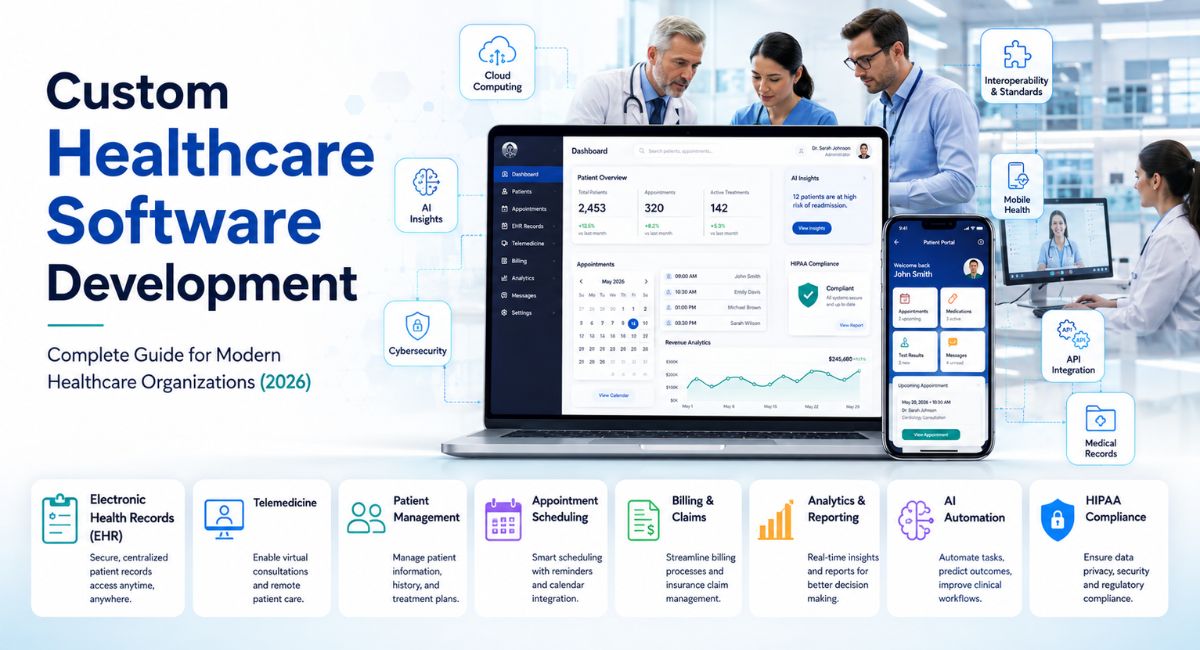
Custom Healthcare Software Development: Complete Guide for Modern Healthcare Organizations 2026
Healthcare organizations generate massive amounts of patient data every day. They manage appointments, electronic health records, billing, insurance claims, telemedicine, prescriptions, and regulatory compliance—all while striving to provide excellent patient care.
Unfortunately, many healthcare providers still rely on outdated software or multiple disconnected systems that slow down operations, increase administrative work, and create unnecessary risks.
This is where custom healthcare software development becomes valuable.
Instead of adapting your workflows to generic software, custom solutions are designed around your organization’s unique processes, clinical requirements, and long-term business goals.
In this guide, you’ll learn:
- What custom healthcare software development is
- How it differs from off-the-shelf software
- Types of healthcare software you can build
- Essential features and compliance requirements
- Development process and estimated costs
- Best practices for choosing a development partner
- Future trends shaping healthcare technology
Whether you’re a hospital administrator, healthcare startup founder, medical practice owner, or digital health entrepreneur in the United States, this guide will help you make informed technology decisions.
What Is Custom Healthcare Software Development?
Custom healthcare software development is the process of designing, building, testing, and maintaining software specifically tailored to the needs of healthcare organizations instead of purchasing ready-made solutions.
Unlike commercial software built for thousands of users, custom applications are created to solve specific operational, clinical, or patient-related challenges.
Examples include:
- Electronic Health Record (EHR) systems
- Telemedicine platforms
- Patient portals
- Hospital management systems
- Medical billing software
- Remote patient monitoring applications
- Laboratory Information Management Systems (LIMS)
- Pharmacy management software
- Healthcare CRM solutions
These systems can integrate with existing medical devices, third-party applications, insurance providers, and government reporting systems.
Why Healthcare Organizations Choose Custom Software
Every healthcare provider operates differently.
A large hospital network has very different requirements than:
- Private medical practices
- Dental clinics
- Mental health providers
- Home healthcare agencies
- Rehabilitation centers
- Diagnostic laboratories
- Healthtech startups
Generic software often forces organizations to change their workflows.
Custom software does the opposite—it supports existing clinical and administrative processes while improving efficiency.
Better Workflow Efficiency
Healthcare professionals already deal with busy schedules.
Custom software can:
- Reduce duplicate data entry
- Automate repetitive administrative tasks
- Improve appointment scheduling
- Simplify patient registration
- Streamline communication between departments
The result is more time for patient care.
Improved Patient Experience
Patients now expect digital healthcare services similar to online banking or e-commerce.
Custom solutions can provide:
- Online appointment booking
- Secure messaging
- Digital prescriptions
- Medical record access
- Telehealth consultations
- Appointment reminders
These features improve convenience while increasing patient satisfaction.
Stronger Data Security
Healthcare data is among the most sensitive information any organization manages.
Custom software allows developers to implement security measures tailored to your specific risks instead of relying on generic configurations.
Common security features include:
- Multi-factor authentication
- Role-based access control
- End-to-end encryption
- Audit logs
- Secure backups
- Automatic threat monitoring
Custom Software vs Off-the-Shelf Healthcare Software
| Feature | Custom Healthcare Software | Off-the-Shelf Software |
| Customization | Fully tailored | Limited |
| Scalability | High | Moderate |
| Ownership | Complete control | Vendor-controlled |
| Integration | Built for existing systems | Often limited |
| Initial Cost | Higher | Lower |
| Long-Term Value | Excellent | Depends on licensing |
| Maintenance | Flexible | Vendor schedule |
When Off-the-Shelf Software Makes Sense
Pre-built software works well if you:
- Have standard workflows
- Need rapid deployment
- Have a limited budget
- Don’t require advanced integrations
When Custom Development Is the Better Choice
Choose custom healthcare software when you need:
- Unique workflows
- Complex integrations
- High scalability
- Competitive differentiation
- Greater control over security
- Long-term technology investment
Types of Custom Healthcare Software
Healthcare technology covers many specialized applications.
Electronic Health Record (EHR) Systems
EHR platforms centralize patient information including:
- Medical history
- Diagnoses
- Lab reports
- Prescriptions
- Imaging records
- Clinical notes
A customized EHR can significantly improve physician productivity.
Hospital Management Systems
Hospitals often require integrated systems for:
- Patient admissions
- Bed management
- Pharmacy
- Billing
- Inventory
- Human resources
- Laboratory services
Custom dashboards also provide administrators with real-time operational insights.
Telemedicine Platforms
Virtual healthcare continues to grow across the United States.
Modern telehealth platforms include:
- Video consultations
- Appointment scheduling
- Digital prescriptions
- Secure messaging
- Payment processing
- Patient records
Patient Portals
Patient portals improve communication by allowing users to:
- View medical records
- Download reports
- Pay bills
- Book appointments
- Request prescription refills
- Receive test results
Remote Patient Monitoring
Wearable devices and IoT sensors allow healthcare providers to monitor patients remotely.
Examples include:
- Blood pressure monitoring
- Heart rate tracking
- Diabetes management
- Oxygen monitoring
- Chronic disease management
Healthcare Mobile Apps
Mobile applications support both patients and clinicians.
Examples include:
- Medication reminders
- Mental health tracking
- Fitness monitoring
- Women’s health apps
- Chronic disease management
- Doctor-on-demand services
Essential Features of Modern Healthcare Software
Successful healthcare applications balance usability, security, and compliance.
Secure User Authentication
Healthcare applications should support:
- Multi-factor authentication
- Biometric login
- Password policies
- Session management
Appointment Scheduling
Patients increasingly expect online scheduling with:
- Calendar synchronization
- SMS reminders
- Email notifications
- Waitlist management
Electronic Prescriptions
Digital prescribing reduces paperwork while improving medication accuracy.
Medical Billing
Integrated billing systems simplify:
- Insurance claims
- Payment tracking
- Coding
- Invoice generation
Analytics and Reporting
Healthcare leaders rely on dashboards to monitor:
- Patient outcomes
- Financial performance
- Appointment trends
- Staff productivity
- Compliance metrics
Third-Party Integrations
Healthcare software often connects with:
- EHR platforms
- Insurance providers
- Payment gateways
- Laboratory systems
- Pharmacy databases
- Medical devices
- Cloud storage
Healthcare Compliance Requirements in the United States
Compliance is one of the most important aspects of healthcare software development.
Ignoring regulations can result in severe financial penalties and reputational damage.
HIPAA Compliance
Healthcare software must protect patient health information (PHI).
Key HIPAA requirements include:
- Data encryption
- Access controls
- Audit trails
- Secure backups
- Risk assessments
- Employee access management
HITECH Act
The HITECH Act strengthens electronic health record adoption and increases security requirements for healthcare organizations.
FDA Regulations
Some Software as a Medical Device (SaMD) solutions may require FDA oversight depending on their intended use.
Interoperability Standards
Healthcare software increasingly supports standards such as:
- HL7
- FHIR
- DICOM
These standards improve communication between healthcare systems.
The Custom Healthcare Software Development Process
A structured development process reduces risk and improves project outcomes.
1. Discovery and Planning
This phase identifies:
- Business objectives
- User needs
- Compliance requirements
- Technical challenges
- Budget
- Timeline
2. UI/UX Design
Healthcare professionals work under pressure.
Interfaces should prioritize:
- Simplicity
- Accessibility
- Fast navigation
- Mobile responsiveness
3. Software Development
Developers build:
- Front-end interfaces
- Backend architecture
- APIs
- Databases
- Integrations
4. Quality Assurance
Testing includes:
- Functional testing
- Security testing
- Performance testing
- Compliance validation
- User acceptance testing
5. Deployment
Deployment often occurs in phases to minimize operational disruption.
6. Ongoing Maintenance
Healthcare software requires continuous:
- Security updates
- Feature enhancements
- Bug fixes
- Compliance updates
- Performance optimization
How Much Does Custom Healthcare Software Development Cost?
Project costs vary depending on complexity, integrations, compliance, and functionality.
Typical ranges include:
| Project Type | Estimated Cost |
| Simple healthcare app | $30,000–$80,000 |
| Mid-sized healthcare platform | $80,000–$250,000 |
| Enterprise healthcare solution | $250,000–$1,000,000+ |
Major cost factors include:
- Features
- Security requirements
- Integrations
- Cloud infrastructure
- Mobile support
- AI capabilities
- Compliance testing
- Maintenance
Rather than focusing only on initial development costs, organizations should evaluate the total cost of ownership over several years.
How to Choose the Right Healthcare Software Development Company
Selecting the right technology partner has a major impact on project success.
Look for companies with:
Proven Healthcare Experience
Healthcare regulations differ significantly from other industries.
Ask for examples of previous healthcare projects.
Strong Security Practices
Verify experience with:
- HIPAA
- Data encryption
- Secure cloud architecture
- Penetration testing
Transparent Development Process
Reliable companies provide:
- Project timelines
- Regular updates
- Milestone reviews
- Documentation
- Ongoing support
Scalable Technology Stack
Choose modern technologies that support future growth instead of requiring expensive rebuilds.
Internal Linking Opportunity: Link to a related service page such as Healthcare Software Development Services or a guide on Choosing a Software Development Company.
Future Trends in Healthcare Software Development
Healthcare technology continues to evolve rapidly.
Some of the biggest trends include:
Artificial Intelligence
AI supports:
- Medical imaging
- Predictive analytics
- Clinical decision support
- Administrative automation
Remote Healthcare
Remote monitoring continues to expand for chronic disease management and elderly care.
Cloud-Based Healthcare Platforms
Cloud infrastructure improves scalability, disaster recovery, and collaboration across healthcare organizations.
Internet of Medical Things (IoMT)
Connected medical devices generate real-time patient data for better clinical decisions.
Blockchain
Blockchain technology may improve medical record sharing while enhancing data integrity and transparency.
Common Mistakes to Avoid
Organizations often encounter avoidable challenges during software projects.
Common mistakes include:
- Ignoring compliance requirements
- Underestimating integration complexity
- Choosing vendors based only on price
- Skipping user testing
- Neglecting cybersecurity
- Failing to plan for future scalability
Addressing these issues early can save significant time and costs later.
Frequently Asked Questions
What is custom healthcare software development?
Custom healthcare software development involves creating software specifically designed for a healthcare organization’s unique workflows, compliance requirements, and operational needs instead of using generic software.
Is custom healthcare software HIPAA compliant?
It can be. HIPAA compliance depends on how the software is designed, implemented, secured, and maintained. Compliance requires technical, administrative, and physical safeguards.
How long does healthcare software development take?
A simple application may take three to six months, while enterprise healthcare platforms often require nine to eighteen months or longer, depending on project complexity.
Why is custom software better than off-the-shelf healthcare software?
Custom software offers greater flexibility, improved integrations, stronger security controls, and scalability tailored to your organization’s long-term goals.
What technologies are commonly used in healthcare software development?
Common technologies include cloud platforms, AI, APIs, FHIR, HL7, mobile frameworks, secure databases, and modern web development frameworks.
May you like: Corporate Software Inspector: Complete Guide for Businesses in 2026
Conclusion
Custom healthcare software development helps healthcare organizations deliver better patient experiences, improve operational efficiency, strengthen security, and adapt to changing industry requirements. While off-the-shelf platforms can meet basic needs, custom solutions provide the flexibility, scalability, and integration capabilities required by modern healthcare providers.
For organizations in the United States, success depends on more than building features. It requires careful planning, user-focused design, robust security, HIPAA compliance, and a reliable long-term technology strategy.
If you’re evaluating a healthcare technology initiative, start by documenting your business goals, identifying workflow challenges, and consulting experienced healthcare software professionals. You can also explore related resources on healthcare software development, HIPAA compliance, or digital transformation strategies to make a more informed decision before beginning your project.