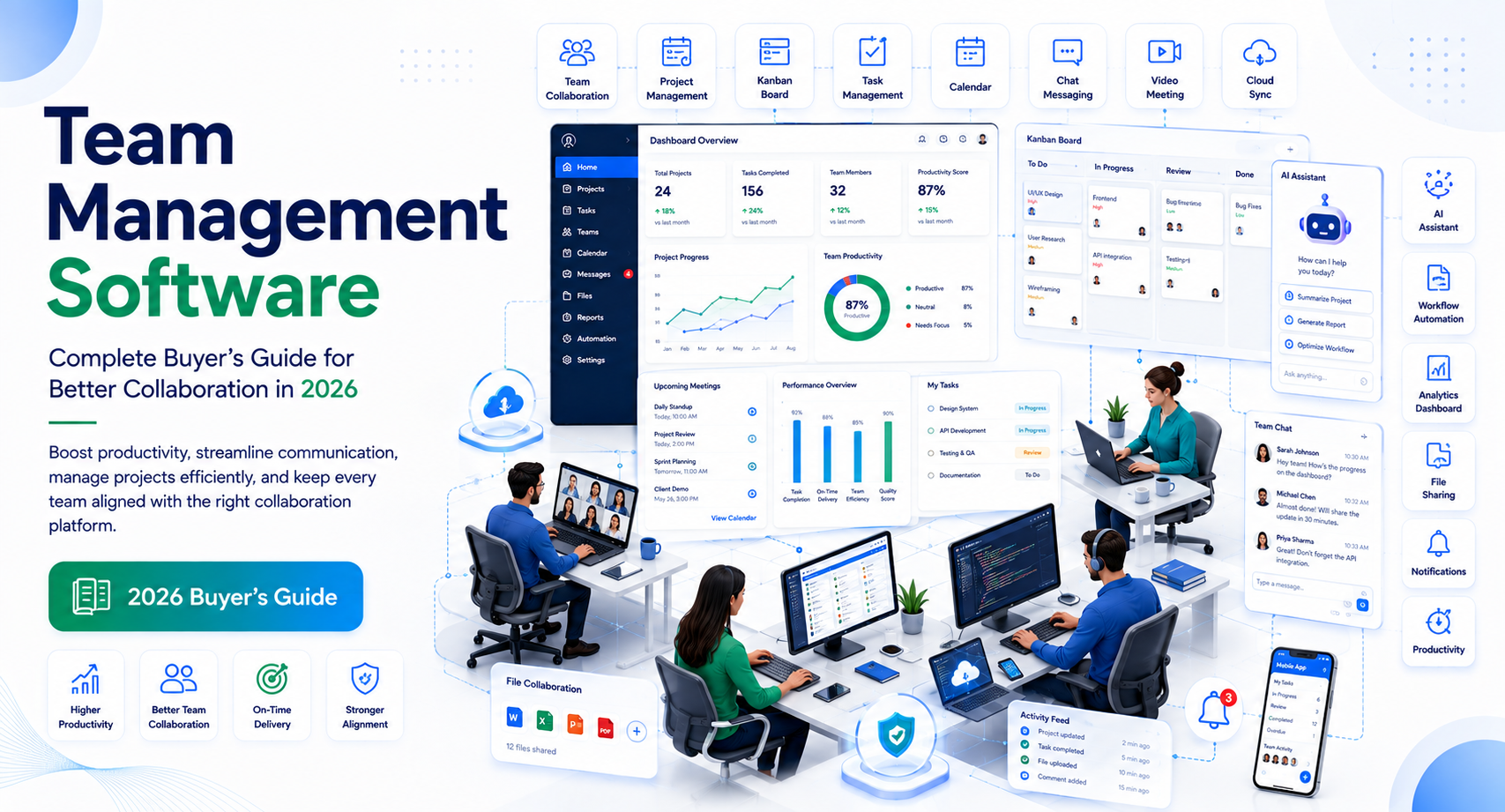
Team Management Software: Complete Buyer’s Guide for Better Collaboration in 2026
Managing a modern team is more challenging than ever. Employees may work from different cities, states, or even countries, while projects involve multiple departments, tight deadlines, and constant communication. Without the right systems in place, tasks can be missed, collaboration suffers, and productivity declines.
This is why businesses across the United States are investing in team management software. These platforms bring communication, task management, project planning, file sharing, reporting, and collaboration into one centralized workspace. Instead of switching between multiple apps, teams can manage daily work from a single platform.
Whether you’re leading a startup, managing a marketing agency, running a software development company, or overseeing remote employees, choosing the right solution can significantly improve efficiency.
In this guide, you’ll learn:
- What team management software is
- Why businesses use it
- Essential features to look for
- Benefits for remote and hybrid teams
- How to compare different solutions
- What to consider before making a purchase
If you’re searching for the best project management software for remote marketing teams or a broader collaboration platform for your organization, this guide will help you make a confident decision.
What Is Team Management Software?
Team management software is a digital platform that helps organizations plan projects, assign tasks, communicate with employees, monitor progress, and improve collaboration.
Instead of relying on email threads, spreadsheets, and disconnected tools, team management software centralizes work in one place, making it easier to track responsibilities and deadlines.
Most platforms include features such as:
- Task management
- Project planning
- Team communication
- File sharing
- Calendar scheduling
- Time tracking
- Reporting dashboards
- Workflow automation
Many modern solutions are cloud-based, allowing employees to access projects securely from any location using a computer, tablet, or smartphone.
Why Businesses Need Team Management Software
As businesses grow, coordinating projects becomes increasingly complex.
Without a centralized system, common problems include:
- Missed deadlines
- Duplicate work
- Poor communication
- Limited visibility into project status
- Difficulty managing remote employees
- Inconsistent workflows
Team management software addresses these challenges by providing a structured environment where everyone can see priorities, deadlines, and responsibilities.
For organizations with distributed workforces, this visibility is especially valuable.
Key Benefits of Team Management Software
Choosing the right platform can improve both team productivity and overall business performance.
Better Collaboration
Employees often work across departments such as marketing, sales, design, customer support, and product development.
A shared workspace enables everyone to:
- View project updates
- Share documents
- Leave comments
- Track progress
- Resolve issues more quickly
This reduces communication gaps and keeps projects moving forward.
Improved Productivity
When tasks are clearly assigned and deadlines are visible, employees spend less time searching for information or determining priorities.
Automation further improves efficiency by reducing repetitive administrative work.
Examples include:
- Task assignments
- Deadline reminders
- Status updates
- Approval workflows
- Recurring projects
Greater Transparency
Managers gain real-time visibility into project performance.
Dashboards typically display:
- Task completion rates
- Project timelines
- Team workload
- Upcoming deadlines
- Resource allocation
This helps leaders identify bottlenecks before they become major problems.
Better Accountability
Every task includes an owner, deadline, and progress status.
This makes responsibilities clear while reducing confusion over who is responsible for specific deliverables.
Supports Remote and Hybrid Work
Cloud-based collaboration allows employees to work effectively regardless of location.
Remote teams can access:
- Documents
- Task lists
- Project updates
- Team discussions
- Shared calendars
from virtually anywhere with an internet connection.
Essential Features to Look For
Not every platform offers the same capabilities.
The best solution depends on your organization’s size, workflow, and collaboration needs.
Task Management
Effective task management allows users to:
- Create tasks
- Assign responsibilities
- Set priorities
- Add due dates
- Track progress
Clear task ownership helps projects stay organized.
Project Planning
Project planning tools typically include:
- Kanban boards
- Gantt charts
- Calendar views
- Timeline planning
- Milestone tracking
These features help teams visualize project schedules and dependencies.
Team Communication
Built-in communication reduces the need to switch between multiple applications.
Common communication tools include:
- Comments
- Chat
- File sharing
- Notifications
- Team discussions
Keeping conversations connected to tasks improves context and decision-making.
Time Tracking
Time tracking helps businesses understand how resources are being used.
It is especially useful for:
- Agencies
- Consultants
- Freelancers
- Client billing
- Productivity analysis
Some platforms also generate timesheets automatically.
Workflow Automation
Automation reduces repetitive work by handling routine processes.
Examples include:
- Automatic task creation
- Status changes
- Approval requests
- Deadline reminders
- Notification rules
Automation allows employees to focus on higher-value work.
Reporting and Analytics
Managers need accurate data to make informed decisions.
Reporting dashboards often include:
- Project completion rates
- Team productivity
- Workload distribution
- Time utilization
- Budget tracking
These insights support continuous improvement.
Third-Party Integrations
Most businesses already use multiple software tools.
Look for platforms that integrate with:
- Google Workspace
- Microsoft 365
- Slack
- Zoom
- Dropbox
- CRM software
- Accounting software
Integrations reduce duplicate work while improving productivity.
Team Management Software for Remote Teams
Remote work has fundamentally changed how organizations collaborate.
Without structured workflows, remote employees may experience:
- Communication delays
- Conflicting priorities
- Limited visibility
- Reduced accountability
Team management software helps overcome these challenges through centralized project management and real-time collaboration.
Managers can:
- Monitor project progress
- Balance workloads
- Schedule meetings
- Track deadlines
- Share files securely
Employees benefit from having a single source of truth for every project.
Choosing the Best Project Management Software for Remote Marketing Teams
Marketing teams often manage multiple campaigns simultaneously while collaborating with designers, copywriters, SEO specialists, advertisers, and clients.
The best project management software for remote marketing teams should include features specifically designed for creative collaboration and campaign management.
Look for capabilities such as:
Campaign Planning
Marketing campaigns involve multiple phases including research, content creation, design, approvals, publishing, and reporting.
Timeline views and campaign calendars help teams stay organized.
Content Collaboration
Marketing professionals frequently collaborate on:
- Blog posts
- Social media campaigns
- Email marketing
- Landing pages
- Paid advertising
Version control and commenting simplify feedback without long email chains.
Approval Workflows
Content often requires approval from managers or clients.
Automated approval workflows reduce delays while ensuring accountability.
Marketing Integrations
Look for integrations with tools such as:
- Google Analytics
- Google Drive
- Adobe Creative Cloud
- HubSpot
- Mailchimp
- Canva
These integrations streamline campaign execution.
Performance Reporting
Marketing teams need dashboards that track:
- Campaign progress
- Content production
- Team workload
- Deadlines
- Resource allocation
Combining project tracking with reporting improves operational visibility.
How to Choose the Right Team Management Software
Every organization has different collaboration needs.
Before selecting a platform, evaluate the following factors.
Company Size
Some tools are designed for small businesses, while others support enterprise-scale operations with thousands of users.
Choose software that can grow with your business.
Ease of Use
Even powerful software loses value if employees find it difficult to use.
During product demonstrations or free trials, evaluate:
- Navigation
- Dashboard layout
- Mobile experience
- Task creation
- Reporting interface
An intuitive platform reduces training time and improves adoption.
Scalability
Your software should continue supporting your organization as projects, employees, and clients increase.
Look for flexible pricing and features that accommodate future growth.
Customer Support
Reliable support becomes especially important during implementation.
Evaluate whether vendors provide:
- Live chat
- Email support
- Phone assistance
- Knowledge base
- Video tutorials
- Onboarding services
Responsive customer support can significantly reduce downtime and user frustration.
Internal Linking Opportunity: Link to related resources such as Project Management Software, Task Management Software, CRM Software, Workflow Automation Software, Employee Scheduling Software, or Collaboration Tools.
Best Team Management Software in 2026
The ideal team management platform depends on your company size, workflow, budget, and collaboration needs. Some tools are designed for simple task management, while others provide complete work management solutions with automation, reporting, and integrations.
Below are some of the most widely used platforms in 2026.
1. Asana
Best for: Marketing teams and cross-functional collaboration
Asana is known for its intuitive interface and flexible project planning tools. It supports task management, workflow automation, campaign planning, and goal tracking, making it a popular choice for growing businesses.
Key Features
- Timeline and calendar views
- Workflow automation
- Project portfolios
- Team goals
- Hundreds of third-party integrations
Pros
- Easy to learn
- Excellent collaboration tools
- Strong automation capabilities
2. Monday.com
Best for: Businesses that need customizable workflows
Monday.com allows teams to build custom workflows for marketing, HR, IT, sales, and operations.
Key Features
- Visual dashboards
- Automation templates
- Time tracking
- Resource management
- Custom reporting
Pros
- Highly customizable
- Modern user interface
- Suitable for teams of all sizes
3. ClickUp
Best for: Businesses seeking an all-in-one productivity platform
ClickUp combines project management, task tracking, documentation, goals, whiteboards, and communication into one workspace.
Key Features
- Docs and knowledge base
- Goal tracking
- AI-assisted productivity features
- Custom dashboards
- Agile project management
Pros
- Feature-rich platform
- Competitive pricing
- Flexible customization
4. Trello
Best for: Small businesses and simple project management
Trello uses a Kanban board system that makes task management easy for teams with straightforward workflows.
Key Features
- Drag-and-drop boards
- Checklists
- Labels
- Due dates
- Power-Up integrations
Pros
- Very easy to use
- Quick setup
- Great for small teams
5. Microsoft Planner and Microsoft Teams
Best for: Organizations already using Microsoft 365
Businesses that rely on Microsoft 365 can manage projects directly within the Microsoft ecosystem.
Key Features
- Task planning
- Shared calendars
- Team collaboration
- File sharing
- Microsoft Office integration
Pros
- Familiar interface
- Excellent enterprise integration
- Secure collaboration
6. Notion
Best for: Knowledge management and collaborative documentation
Notion combines documentation, project management, databases, and team collaboration into a highly flexible workspace.
Key Features
- Shared documentation
- Project tracking
- Wikis
- AI writing assistance
- Custom databases
Pros
- Flexible organization
- Excellent documentation tools
- Suitable for startups and creative teams
How Much Does Team Management Software Cost?
Pricing varies depending on features, user count, integrations, storage, and support.
Common pricing models include:
Free Plans
Many vendors offer free versions for individuals or small teams with limited functionality.
These plans are suitable for testing a platform before upgrading.
Per-User Monthly Pricing
Most cloud-based platforms charge a monthly fee for each active user.
This model works well for businesses that expect their teams to grow gradually.
Enterprise Pricing
Large organizations often require:
- Advanced security
- Single sign-on (SSO)
- Custom reporting
- Compliance features
- Dedicated support
- Administrative controls
Enterprise pricing is typically customized based on organizational requirements.
When comparing software, consider the total cost of ownership, including implementation, training, integrations, and ongoing support—not just the subscription price.
Best Practices for Successful Implementation
Selecting the right platform is only the first step. Successful adoption depends on thoughtful implementation and user engagement.
Define Your Objectives
Before rolling out new software, identify the problems you want to solve.
Examples include:
- Improving communication
- Reducing missed deadlines
- Increasing productivity
- Standardizing workflows
- Supporting remote collaboration
Clear objectives help measure success after implementation.
Standardize Workflows
Create consistent processes for:
- Task creation
- Project naming
- Status updates
- File organization
- Approval procedures
Standardized workflows reduce confusion and improve collaboration across departments.
Train Your Team
Even intuitive software requires onboarding.
Training should cover:
- Creating and assigning tasks
- Managing deadlines
- Using dashboards
- Sharing files
- Collaborating on projects
- Generating reports
Well-trained employees are more likely to adopt the platform successfully.
Start With a Pilot Team
Rather than deploying the software company-wide immediately, begin with one department or project team.
Gather feedback, refine workflows, and resolve issues before expanding to the rest of the organization.
Monitor Adoption and Performance
After implementation, track metrics such as:
- User adoption rates
- Task completion times
- Project delivery performance
- Employee engagement
- Workflow efficiency
Regular reviews help identify opportunities for continuous improvement.
Common Mistakes to Avoid
Many organizations fail to realize the full value of team management software because of avoidable mistakes.
Choosing Software Based Only on Price
The least expensive platform may lack the features, integrations, or scalability your business needs.
Evaluate long-term value rather than upfront cost alone.
Ignoring User Experience
Complicated software often leads to poor adoption.
Select a platform that employees can learn quickly and use consistently.
Overcomplicating Workflows
Creating too many project stages, automation rules, or approval layers can reduce productivity instead of improving it.
Keep workflows as simple as possible while meeting business requirements.
Failing to Integrate Existing Tools
Disconnected systems increase manual work and data duplication.
Whenever possible, integrate your team management platform with existing CRM, communication, document storage, and accounting tools.
Not Reviewing Performance
Implementation is not a one-time event.
Regularly evaluate workflows, reports, and user feedback to ensure the software continues to meet business needs as your organization grows.
Trends Shaping Team Management Software in 2026
Work management continues to evolve as organizations embrace hybrid work, automation, and artificial intelligence.
AI-Powered Productivity
Artificial intelligence is helping teams:
- Prioritize tasks
- Generate meeting summaries
- Create project updates
- Predict workload bottlenecks
- Automate repetitive administrative work
These features allow employees to spend more time on strategic work.
Hybrid Work Optimization
Modern platforms are increasingly designed to support distributed teams by offering seamless collaboration across offices, home environments, and mobile devices.
Workflow Automation
Businesses continue to automate repetitive processes such as approvals, notifications, recurring tasks, and reporting, reducing manual effort and improving consistency.
Advanced Analytics
Real-time dashboards are becoming more sophisticated, providing insights into project health, resource utilization, productivity trends, and workload balancing.
These analytics help managers make informed decisions based on measurable performance.
Stronger Security and Compliance
As organizations store more sensitive business information in cloud-based collaboration platforms, vendors continue to enhance security with features such as multi-factor authentication, role-based permissions, audit logs, and data encryption.
Frequently Asked Questions
What is team management software?
Team management software is a digital platform that helps businesses organize projects, assign tasks, improve communication, monitor progress, and collaborate more effectively across teams.
What features should I look for in team management software?
Look for task management, project planning, team communication, workflow automation, reporting, time tracking, mobile access, and integrations with the business tools your organization already uses.
Is team management software suitable for small businesses?
Yes. Many platforms offer affordable plans designed for startups and small businesses, with the flexibility to scale as teams grow.
What is the best project management software for remote marketing teams?
The best solution depends on your workflow and budget. Platforms such as Asana, Monday.com, ClickUp, and Notion are popular choices because they combine campaign planning, collaboration, reporting, and marketing tool integrations in one workspace.
How can businesses improve adoption of new team management software?
Successful adoption depends on clear goals, employee training, standardized workflows, leadership support, and regular reviews to ensure the software aligns with business processes.
May you like: Corporate Software Inspector: Complete Guide for Businesses in 2026
Conclusion
As organizations continue to embrace hybrid work and cross-functional collaboration, team management software has become an essential business tool rather than a convenience. A well-chosen platform improves communication, keeps projects organized, increases accountability, and provides leaders with the visibility needed to make informed decisions.
Whether you’re managing a growing startup, an established enterprise, or searching for the best project management software for remote marketing teams, focus on solutions that fit your workflow, integrate with your existing technology, and can scale alongside your business.
Before making a final decision, take advantage of free trials, involve key stakeholders in the evaluation process, and compare features beyond price alone. You may also benefit from exploring related guides on project management software, workflow automation, CRM software, employee scheduling software, and business collaboration tools to build a more connected and productive digital workplace.