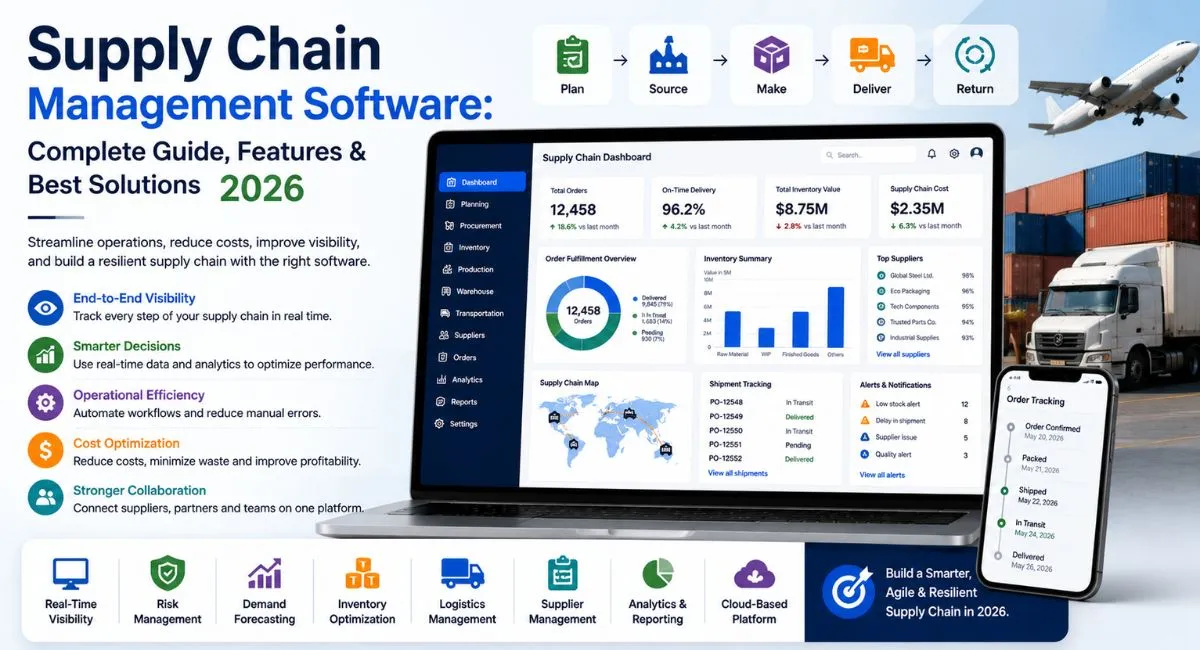
Supply Chain Management Software: Complete Guide, Features & Best Solutions 2026
Introduction
Running a modern supply chain without the right technology is a bit like trying to navigate a busy city with a paper map from ten years ago. You might eventually reach your destination, but you’ll waste time, money, and patience along the way.
Today’s businesses face rising customer expectations, global supplier networks, inventory challenges, transportation delays, and increasing market uncertainty. To stay competitive, companies need better visibility, faster decision-making, and more efficient operations. This is where supply chain management software becomes essential.
Supply chain management software helps organizations plan, manage, monitor, and optimize the flow of products, information, and resources across the entire supply chain. From forecasting demand to tracking shipments in real time, these platforms help businesses improve efficiency while reducing costs.
What Is Supply Chain Management Software?
Definition and Purpose
Supply chain management (SCM) software is a digital solution that helps businesses coordinate activities across procurement, inventory, warehousing, transportation, manufacturing, and order fulfillment.
Its primary goal is simple: help companies move products from suppliers to customers as efficiently as possible.
Modern SCM platforms bring together data from multiple departments and provide a centralized view of supply chain operations. This allows teams to make informed decisions based on real-time information rather than guesswork.
How SCM Software Works
SCM software collects data from various systems, including ERP platforms, suppliers, warehouses, transportation providers, and sales channels.
The software then analyzes this information to help businesses:
- Forecast customer demand
- Monitor inventory levels
- Manage supplier relationships
- Optimize transportation routes
- Track orders and shipments
- Identify operational bottlenecks
Instead of reacting to problems after they occur, organizations can identify risks early and take proactive action.
Why Supply Chain Management Software Matters
Common Supply Chain Challenges
Supply chains have become increasingly complex. Businesses often struggle with:
- Inventory shortages
- Excess stock
- Supplier disruptions
- Delivery delays
- Demand fluctuations
- Limited visibility across operations
Even a small disruption can create a ripple effect throughout the entire supply chain.
Benefits of Using SCM Software
The right supply chain management software provides several advantages:
- Better inventory control
- Improved forecasting accuracy
- Faster order fulfillment
- Reduced operational costs
- Increased supply chain visibility
- Stronger supplier collaboration
According to recent industry research, organizations continue investing heavily in AI-enabled visibility, analytics, and automation to improve resilience and decision-making across supply chain operations.
Key Features of Supply Chain Management Software
Demand Forecasting
Demand forecasting helps businesses predict future customer demand using historical data, market trends, and advanced analytics.
Accurate forecasting reduces stockouts and prevents overstock situations that tie up working capital.
Inventory Management
Inventory management tools help companies monitor stock levels across multiple locations.
Businesses can maintain optimal inventory levels while reducing carrying costs and minimizing waste.
Procurement and Supplier Management
Supplier management features help organizations evaluate vendor performance, monitor compliance, and streamline purchasing processes.
Strong supplier relationships often lead to better pricing, improved reliability, and reduced supply chain risk.
Warehouse Management
Warehouse management capabilities improve storage, picking, packing, and inventory tracking.
Efficient warehouses process orders faster and improve customer satisfaction.
Logistics and Transportation Management
Transportation management features optimize shipping routes, carrier selection, and delivery schedules.
These capabilities help reduce transportation expenses while improving delivery performance.
Supply Chain Visibility and Analytics
Visibility tools provide real-time insights into inventory, shipments, suppliers, and operational performance.
Businesses can quickly identify issues before they become expensive problems.
AI and Automation Capabilities
Artificial intelligence is becoming a major driver of supply chain innovation.
AI helps organizations improve forecasting, automate repetitive tasks, detect risks, and support faster decision-making. However, industry research shows that many companies still face challenges related to data quality, integration, and workforce readiness when scaling AI initiatives.
Types of Supply Chain Management Software
Not all SCM solutions serve the same purpose.
Planning Systems
These systems focus on forecasting demand, inventory planning, and supply planning.
Execution Systems
Execution platforms manage day-to-day operations such as procurement, order processing, and fulfillment.
Transportation Management Systems (TMS)
TMS solutions help businesses plan, execute, and optimize freight movement.
Warehouse Management Systems (WMS)
WMS platforms improve warehouse operations and inventory accuracy.
End-to-End SCM Platforms
These comprehensive solutions combine planning, execution, visibility, analytics, and collaboration into a single platform.
Top Supply Chain Management Software Solutions
Several leading vendors dominate the SCM software market:
Oracle SCM Cloud
A comprehensive platform offering planning, procurement, manufacturing, logistics, and analytics capabilities.
SAP Integrated Business Planning
Popular among large enterprises seeking advanced planning and forecasting functionality.
Blue Yonder
Known for AI-driven planning, inventory optimization, and supply chain visibility.
Kinaxis Maestro
Designed to support rapid scenario planning and real-time decision-making.
E2open
Provides end-to-end visibility across complex global supply networks.
Infor Nexus
Focuses on supply chain collaboration and global commerce management.
NetSuite SCM
A cloud-based solution well suited for growing businesses seeking integrated ERP and supply chain functionality.
Manhattan Active Supply Chain Planning
Widely used in retail and distribution environments.
Logility
Offers AI-powered planning and optimization capabilities.
RELEX Solutions
Popular among retailers and consumer goods companies for forecasting and replenishment planning.
How to Choose the Right Supply Chain Management Software
Choosing software solely because it looks impressive during a demo is rarely a winning strategy.
Consider the following factors:
Business Size
Small businesses often need simpler solutions, while enterprises require advanced functionality and scalability.
Industry Requirements
Manufacturing, retail, healthcare, and logistics companies face different supply chain challenges.
Integration Requirements
Your SCM platform should integrate smoothly with existing ERP, CRM, and warehouse systems.
Scalability
Choose software that can support future growth without requiring a complete replacement.
Total Cost of Ownership
Look beyond subscription fees. Consider implementation, training, maintenance, and support costs.
Supply Chain Management Software by Industry
Different industries use SCM software in different ways.
Manufacturing
Manufacturers use SCM solutions for production planning, inventory optimization, and supplier coordination.
Retail and Ecommerce
Retailers rely on demand forecasting, replenishment planning, and omnichannel inventory management.
Wholesale Distribution
Distributors use SCM software to improve order fulfillment and inventory visibility.
Healthcare
Healthcare organizations use supply chain technology to manage critical medical supplies and improve compliance.
Food and Beverage
Food companies benefit from traceability, inventory control, and quality management capabilities.
Emerging Trends in Supply Chain Management
Several trends are shaping the future of supply chain technology.
Artificial Intelligence
AI continues to improve forecasting, automation, and decision support capabilities across supply chains.
Predictive Analytics
Businesses increasingly use predictive models to anticipate disruptions and improve planning accuracy.
Digital Twins
Digital twins create virtual representations of supply chain operations, allowing organizations to test scenarios before making real-world changes.
Sustainability Tracking
Companies face growing pressure to improve environmental performance and supply chain transparency.
Real-Time Supply Chain Visibility
Real-time visibility has become a strategic priority as organizations seek faster responses to disruptions and market changes.
Supply Chain KPIs Every Business Should Track
Successful supply chains rely on measurable performance indicators.
Key metrics include:
- Inventory Turnover
- Perfect Order Rate
- Order Fulfillment Time
- Supplier Performance
- Forecast Accuracy
Tracking these KPIs helps businesses identify improvement opportunities and measure operational success.
Supply Chain Management Software FAQs
What is SCM software?
SCM software helps businesses manage and optimize supply chain operations from procurement to delivery.
Is SCM software part of ERP?
Some ERP systems include SCM modules, but dedicated SCM platforms often provide more advanced supply chain capabilities.
What are the types of SCM software?
Common categories include planning systems, execution systems, TMS, WMS, and end-to-end SCM platforms.
What is the difference between SCM and logistics?
SCM covers the entire supply chain, while logistics focuses specifically on transportation, storage, and distribution activities.
How does AI improve supply chain management?
AI helps improve forecasting, automate workflows, identify risks, and support faster operational decisions.
Which industries benefit most from SCM software?
Manufacturing, retail, ecommerce, healthcare, food and beverage, and wholesale distribution industries benefit significantly from SCM technology.
May You Like: Corporate Software Inspector: Complete Guide for Businesses in 2026
Final Thoughts
Supply chain management software has evolved from a helpful business tool into a strategic necessity. Modern organizations need visibility, agility, and data-driven decision-making to compete in increasingly complex markets.
Whether you operate a manufacturing facility, an ecommerce brand, or a global distribution network, the right SCM solution can help improve efficiency, reduce costs, and strengthen supply chain resilience.
As AI, predictive analytics, and real-time visibility continue to advance, businesses that invest in modern supply chain technology will be better positioned to navigate disruption and capitalize on future opportunities.