Best Construction Scheduling Software for Construction Companies in 2026
Introduction
Construction projects rarely fail because people lack skills. More often, projects run into trouble because schedules fall apart.
A delayed delivery, a missing subcontractor, bad weather, or poor communication can quickly turn a well-planned project into an expensive headache. When multiple teams, suppliers, equipment, and deadlines must work together, relying on spreadsheets or handwritten schedules becomes risky.
That is why construction scheduling software has become a critical tool for modern construction companies.
Whether you manage residential homes, commercial buildings, infrastructure projects, or specialty contracting work, the right scheduling platform helps keep projects organized, teams aligned, and deadlines under control.
Modern construction scheduling software does much more than create timelines. It helps project managers allocate resources, track progress, monitor costs, manage risks, and collaborate with field teams in real time.
As construction projects become more complex, software-driven scheduling has moved from being a competitive advantage to becoming a business necessity.
In this guide, you’ll learn how construction scheduling software works, which features matter most, and why construction companies across the USA, UK, and Australia continue investing in digital scheduling tools.
What Is Construction Scheduling Software?
Construction scheduling software helps project teams plan, organize, manage, and monitor construction activities throughout a project’s lifecycle.
The software creates a structured schedule that outlines tasks, milestones, deadlines, dependencies, labor requirements, equipment usage, and project progress.
Instead of managing dozens of disconnected spreadsheets, project managers can view everything from a centralized platform.
Construction scheduling software supports projects of all sizes, from small residential renovations to multi-million-dollar commercial developments.
Many modern platforms also connect with accounting software, construction management systems, document management tools, and field reporting applications, creating a single source of truth for project data.
How Construction Scheduling Software Works
At its core, construction scheduling software organizes project activities into a timeline.
Project managers begin by creating tasks and assigning deadlines. The software then connects related tasks through dependencies.
For example:
- Foundation work must finish before framing begins.
- Framing must finish before electrical installation starts.
- Electrical work must finish before drywall installation.
The software automatically calculates how these activities affect the overall project schedule.
Many advanced platforms also support:
- Resource allocation
- Cost tracking
- Critical path analysis
- Progress monitoring
- Real-time reporting
- Schedule forecasting
When a delay occurs, the system updates timelines and highlights potential risks, allowing project teams to take corrective action quickly.
Instead of discovering problems weeks later, managers can respond while there is still time to minimize disruption.
Why Modern Construction Teams Need Scheduling Software
Construction projects involve many moving parts.
A single project may include:
- General contractors
- Subcontractors
- Architects
- Engineers
- Suppliers
- Inspectors
- Equipment operators
Without a centralized scheduling system, communication gaps can emerge quickly.
Construction scheduling software helps eliminate confusion by ensuring everyone works from the same project timeline.
The need for digital scheduling has increased as projects become more complex and clients demand greater transparency.
According to guidance from the Project Management Institute, effective planning, monitoring, and scheduling remain essential factors for successful project delivery.
Construction companies that maintain accurate schedules often gain better control over costs, resources, and project outcomes.
Key Features to Look for in Construction Scheduling Software
Not all construction scheduling software offers the same capabilities.
Some tools focus on simple scheduling, while others provide enterprise-level project controls.
Before choosing a platform, evaluate the following features carefully.
Gantt Charts and Project Timelines
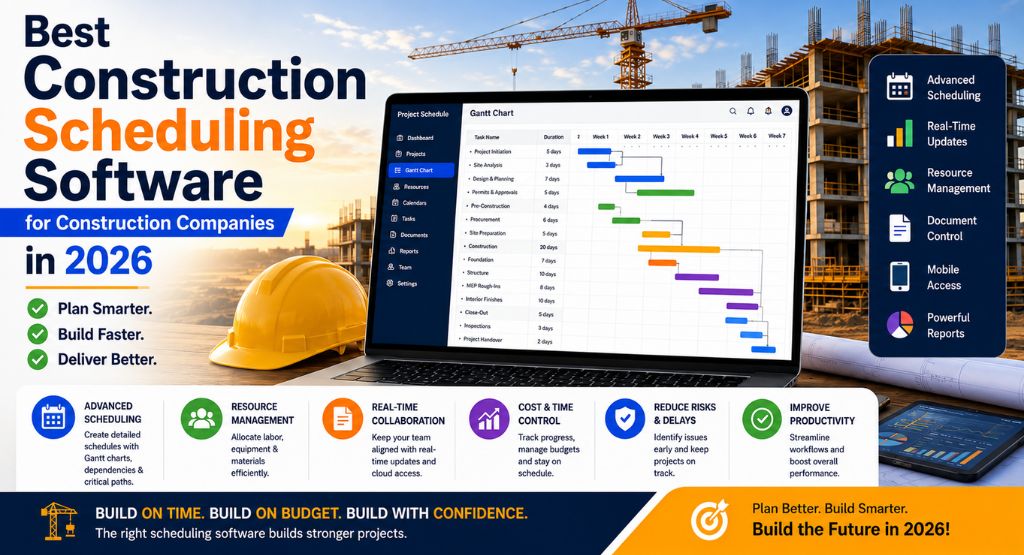
A Gantt chart is one of the most widely used scheduling tools in construction management.
It provides a visual representation of project activities across a timeline.
Project managers can quickly see:
- Task durations
- Dependencies
- Milestones
- Progress status
- Schedule conflicts
The visual nature of Gantt charts makes complex projects easier to understand.
Rather than scrolling through endless task lists, teams can immediately identify what needs attention.
Critical Path Method (CPM) Scheduling
The Critical Path Method (CPM) remains one of the most important scheduling techniques in construction.
CPM identifies the sequence of activities that directly affects the project’s completion date.
If any critical task experiences a delay, the entire project timeline may shift.
Construction scheduling software automatically calculates critical paths and highlights high-risk activities.
This helps project managers prioritize resources where they matter most.
For large commercial projects, CPM analysis often serves as a foundation for schedule planning and progress tracking.
Resource and Labor Management
Even the best schedule can fail if labor and equipment are unavailable.
Resource management features help companies allocate:
- Workers
- Crews
- Machinery
- Vehicles
- Specialized equipment
Managers can identify scheduling conflicts before they become costly problems.
For example, if two projects require the same crane at the same time, the software highlights the conflict immediately.
This visibility improves efficiency and reduces downtime.
Real-Time Progress Tracking
Construction projects rarely unfold exactly as planned.
Weather conditions change.
Deliveries arrive late.
Inspection schedules shift.
Real-time progress tracking allows project managers to monitor field activity as it happens.
Many platforms provide dashboards that display:
- Task completion status
- Schedule performance
- Delayed activities
- Resource utilization
With accurate data available in real time, managers can make faster and better decisions.
Mobile Access for Field Teams
Construction work happens in the field, not behind a desk.
Mobile access allows supervisors, subcontractors, and field personnel to:
- View schedules
- Submit updates
- Upload photos
- Report issues
- Access documents
Field teams can communicate directly from job sites without waiting for office staff to relay information.
This improves responsiveness and keeps everyone aligned.
Document Management
Construction projects generate large amounts of documentation.
Common documents include:
- Drawings
- RFIs
- Contracts
- Change orders
- Inspection reports
- Safety documents
Document management tools store these files in a centralized location.
This reduces confusion and helps teams access the latest project information quickly.
Nobody enjoys searching through email chains to find the most recent blueprint revision.
Budget and Cost Tracking
Time and money remain closely connected in construction.
Schedule delays often lead to increased costs.
Many construction scheduling platforms include budget tracking features that help teams monitor:
- Labor costs
- Equipment expenses
- Material costs
- Project profitability
This visibility supports better financial decision-making throughout the project lifecycle.
Reporting and Analytics
Good decisions require good information.
Reporting tools transform project data into actionable insights.
Construction managers can generate reports covering:
- Schedule performance
- Resource utilization
- Cost trends
- Project risks
- Progress updates
Advanced analytics help organizations identify recurring issues and improve future project planning.
Integrations With Construction Tools
Modern construction companies use multiple software platforms.
A scheduling tool should connect with existing systems whenever possible.
Common integrations include:
- Accounting software
- ERP systems
- Construction management platforms
- Document management solutions
- Time-tracking applications
Strong integrations reduce manual data entry and improve data accuracy.
Benefits of Using Construction Scheduling Software
The right software does more than create schedules.
It helps construction companies operate more efficiently while reducing risks and improving project outcomes.
Reduce Project Delays
Project delays remain one of the biggest challenges in construction.
Scheduling software helps teams identify risks early and monitor critical activities throughout the project.
When delays occur, managers can adjust schedules and allocate resources more effectively.
Early visibility often prevents small issues from becoming major disruptions.
Improve Team Collaboration
Construction projects require constant coordination.
Scheduling software provides a shared workspace where everyone can access current project information.
Instead of relying on phone calls, emails, and paper schedules, teams collaborate through a centralized platform.
This improves communication and reduces misunderstandings.
Increase Resource Utilization
Idle equipment and underutilized labor can significantly impact profitability.
Scheduling tools help managers assign resources efficiently and avoid conflicts.
Better resource planning often leads to improved productivity and reduced operating costs.
Improve Project Profitability
Profitable projects depend on effective planning and execution.
When teams reduce delays, improve resource allocation, and maintain schedule accuracy, project costs become easier to control.
Better scheduling often translates into healthier profit margins.
Enhance Client Communication
Clients want visibility into project progress.
Construction scheduling software makes it easier to provide accurate updates and realistic timelines.
Instead of vague status reports, project managers can share data-driven progress information.
This transparency builds trust and strengthens client relationships.
A well-informed client is usually a happier client—and happier clients tend to generate repeat business and referrals.
Best Construction Scheduling Software Compared
Choosing the best construction scheduling software can feel overwhelming. A quick search reveals dozens of platforms, each claiming to save time, reduce delays, and improve project performance.
The reality is simpler.
The best software depends on your project size, workflow complexity, budget, and reporting requirements.
Some tools excel at enterprise-level scheduling, while others focus on collaboration, ease of use, or residential construction management.
Below are some of the most widely used construction scheduling solutions in 2026.
Oracle Primavera P6
Oracle Primavera P6 remains one of the most respected scheduling platforms in the construction industry.
Large contractors, infrastructure projects, and government-funded developments frequently use Primavera because of its advanced scheduling capabilities.
Key Strengths
- Industry-leading CPM scheduling
- Advanced resource planning
- Multi-project management
- Risk analysis tools
- Strong reporting capabilities
Best For
- Large construction companies
- Infrastructure projects
- Engineering and industrial projects
- Complex multi-phase developments
Potential Limitations
Primavera offers powerful features, but it also comes with a steeper learning curve than many modern cloud-based solutions.
Microsoft Project
Microsoft Project has remained a popular project scheduling solution for decades.
Many construction professionals appreciate its familiar interface and extensive scheduling capabilities.
Key Strengths
- Strong task scheduling
- Detailed Gantt charts
- Resource allocation tools
- Integration with Microsoft products
- Flexible reporting
Best For
- Mid-sized construction companies
- Project managers familiar with Microsoft tools
- Organizations seeking detailed project planning
Potential Limitations
Collaboration features may not feel as construction-specific as some modern platforms.
Procore
Procore has become one of the most recognized construction management platforms worldwide.
Its scheduling capabilities work alongside document management, financial tracking, quality control, and field collaboration tools.
Key Strengths
- Construction-specific workflows
- Excellent field collaboration
- Mobile-first experience
- Centralized project management
- Strong document control
Best For
- General contractors
- Commercial builders
- Growing construction firms
Potential Limitations
Some smaller contractors may find the platform larger than their immediate needs.
Autodesk Build
Autodesk Build combines scheduling, collaboration, document management, and field execution within a unified platform.
Companies already using Autodesk products often appreciate the ecosystem integration.
Key Strengths
- Strong BIM connectivity
- Field management tools
- Real-time project visibility
- Construction-focused workflows
- Cloud-based collaboration
Best For
- Commercial construction
- Design-build firms
- BIM-driven projects
Potential Limitations
Organizations unfamiliar with Autodesk products may require additional onboarding.
Smartsheet
Smartsheet brings spreadsheet-style simplicity to project scheduling.
Many teams adopt it because it combines familiar spreadsheet functionality with project management features.
Key Strengths
- Easy-to-use interface
- Flexible project tracking
- Automation features
- Team collaboration tools
- Custom dashboards
Best For
- Small to mid-sized construction firms
- Teams transitioning from spreadsheets
- Project managers seeking flexibility
Potential Limitations
Large enterprise projects may require more specialized construction functionality.
Monday.com
Monday.com focuses on simplicity, customization, and team collaboration.
Its visual interface makes project tracking straightforward for both office and field teams.
Key Strengths
- User-friendly design
- Workflow automation
- Visual project tracking
- Strong collaboration tools
- Customizable dashboards
Best For
- Small contractors
- Growing construction teams
- Companies seeking fast adoption
Potential Limitations
Advanced scheduling requirements may exceed its core capabilities.
Fieldwire
Fieldwire focuses heavily on field operations and jobsite collaboration.
It helps connect office teams with field personnel through mobile-first project management.
Key Strengths
- Excellent mobile functionality
- Field reporting tools
- Punch list management
- Task tracking
- Document sharing
Best For
- Field supervisors
- Specialty contractors
- Jobsite-focused teams
Potential Limitations
Organizations requiring advanced enterprise scheduling may need additional planning tools.
TeamGantt
TeamGantt centers its platform around visual scheduling and Gantt chart management.
Its simplicity appeals to teams that prioritize clarity and ease of use.
Key Strengths
- Intuitive scheduling interface
- Visual timeline management
- Team collaboration
- Progress tracking
- Easy implementation
Best For
- Small construction companies
- Project coordinators
- Teams seeking visual scheduling
Potential Limitations
Complex enterprise environments may require more advanced controls.
CoConstruct
CoConstruct specializes in residential construction and remodeling projects.
Many custom home builders use it to manage scheduling, budgeting, and client communication.
Key Strengths
- Residential construction focus
- Client communication tools
- Budget tracking
- Scheduling functionality
- Change order management
Best For
- Home builders
- Remodelers
- Residential contractors
Potential Limitations
Large commercial contractors may require broader enterprise functionality.
Buildertrend
Buildertrend serves residential builders, remodelers, and specialty contractors.
The platform combines scheduling with sales, financial management, and customer communication tools.
Key Strengths
- Construction-specific workflows
- Client portal features
- Scheduling and budgeting
- Mobile accessibility
- Strong customer communication
Best For
- Residential builders
- Renovation companies
- Specialty contractors
Potential Limitations
Large infrastructure projects may require more advanced scheduling capabilities.
Construction Scheduling Software Comparison Table
Features Comparison
When comparing construction scheduling software, focus on the capabilities that directly affect project performance.
| Software | CPM Scheduling | Resource Management | Mobile Access | Document Management | Reporting |
| Primavera P6 | Excellent | Excellent | Good | Good | Excellent |
| Microsoft Project | Excellent | Excellent | Moderate | Moderate | Excellent |
| Procore | Good | Good | Excellent | Excellent | Good |
| Autodesk Build | Good | Good | Excellent | Excellent | Good |
| Smartsheet | Moderate | Good | Good | Moderate | Good |
| Monday.com | Moderate | Moderate | Good | Moderate | Good |
| Fieldwire | Moderate | Moderate | Excellent | Good | Good |
| TeamGantt | Moderate | Moderate | Good | Basic | Moderate |
| CoConstruct | Good | Good | Good | Good | Good |
| Buildertrend | Good | Good | Good | Good | Good |
Pricing Comparison
Construction software pricing varies significantly based on:
- Number of users
- Project volume
- Feature requirements
- Support needs
- Enterprise functionality
Most vendors provide custom pricing for larger organizations.
Smaller contractors often prefer subscription-based platforms because they require lower upfront investment.
Before making a decision, request a demonstration and obtain a detailed pricing proposal.
Best Use Cases
Different software serves different business needs.
Best for Enterprise Projects
- Oracle Primavera P6
- Autodesk Build
Best for General Contractors
- Procore
- Microsoft Project
Best for Residential Construction
- Buildertrend
- CoConstruct
Best for Small Construction Businesses
- Monday.com
- TeamGantt
Best for Field Collaboration
- Fieldwire
- Procore
How to Choose the Right Construction Scheduling Software
The best software is not necessarily the platform with the longest feature list.
The right solution solves your specific operational challenges.
Based on Company Size
Small contractors often prioritize:
- Ease of use
- Fast implementation
- Affordable pricing
Large construction companies usually need:
- Multi-project management
- Resource forecasting
- Enterprise reporting
- Advanced schedule controls
Selecting software that matches organizational size helps avoid unnecessary complexity.
Based on Project Complexity
Simple residential projects rarely require the same scheduling capabilities as a multi-year infrastructure project.
Consider:
- Project duration
- Number of stakeholders
- Resource requirements
- Regulatory complexity
- Reporting needs
The more complex the project, the more important advanced scheduling functionality becomes.
Based on Budget
Software should support profitability rather than reduce it.
Look beyond subscription costs.
Evaluate:
- Implementation expenses
- Training costs
- Support fees
- Integration costs
- Long-term scalability
A lower monthly price does not always translate into a lower total cost of ownership.
Based on Integration Needs
Construction companies rarely operate using a single software platform.
Your scheduling solution should work well with existing systems such as:
- Accounting software
- ERP platforms
- Document management systems
- Estimating software
- Time-tracking tools
Strong integrations improve data accuracy and reduce administrative work.
A scheduling platform that fits naturally into your technology stack often delivers better long-term value than a standalone solution.
Construction Scheduling Methods Explained
Even the best construction scheduling software cannot guarantee project success if teams use poor scheduling practices.
That is why understanding proven scheduling methodologies remains just as important as selecting the right software.
Modern construction companies often combine technology with established scheduling techniques to improve planning accuracy and project execution.
Gantt Charts
Gantt charts remain one of the most widely used scheduling methods in construction.
A Gantt chart displays project activities on a visual timeline, making it easier to understand task durations, milestones, and dependencies.
Project managers use Gantt charts to:
- Track project progress
- Identify schedule conflicts
- Monitor deadlines
- Communicate timelines to stakeholders
One reason Gantt charts remain popular is their simplicity. Even team members without formal scheduling experience can quickly understand a visual project timeline.
Most leading construction scheduling software platforms include built-in Gantt chart functionality.
Critical Path Method (CPM)
The Critical Path Method (CPM) is one of the most important scheduling techniques used in construction project management.
CPM identifies the sequence of activities that directly affects the project’s completion date.
These activities form the “critical path.”
If a task on the critical path gets delayed, the entire project schedule may also shift.
Project managers use CPM to:
- Prioritize critical activities
- Allocate resources efficiently
- Forecast project completion dates
- Reduce scheduling risks
Many large commercial and infrastructure projects rely heavily on CPM analysis because even small delays can create significant financial consequences.
Pull Planning
Pull Planning is a collaborative scheduling method commonly used in Lean Construction.
Unlike traditional scheduling, which starts at the beginning and moves forward, Pull Planning starts with the project’s completion milestone and works backward.
Project teams identify:
- Required milestones
- Key deliverables
- Dependencies
- Resource requirements
This approach encourages collaboration among contractors, subcontractors, and project stakeholders.
The result is often a more realistic and achievable project schedule.
Last Planner System
The Last Planner System (LPS) is another Lean Construction methodology designed to improve planning reliability.
The system focuses on involving the people responsible for completing the work.
Rather than relying solely on top-down scheduling, field supervisors and trade partners participate in planning activities.
Benefits include:
- Better schedule reliability
- Increased accountability
- Improved communication
- Reduced workflow interruptions
Many construction organizations use software platforms that support Last Planner workflows and collaborative scheduling processes.
Construction Scheduling Software by Business Type
Different construction companies face different scheduling challenges.
Choosing software that aligns with your business model often leads to better results.
Residential Contractors
Residential construction projects typically involve:
- Home building
- Renovations
- Remodeling projects
- Small development projects
Residential contractors often benefit from software that combines scheduling, budgeting, customer communication, and document management.
Popular options include:
- Buildertrend
- CoConstruct
- Monday.com
These platforms help streamline communication with homeowners while simplifying project coordination.
Commercial Builders
Commercial construction projects usually involve:
- Office buildings
- Retail spaces
- Hotels
- Educational facilities
These projects often require more sophisticated scheduling tools because of their complexity.
Commercial builders frequently choose:
- Procore
- Autodesk Build
- Microsoft Project
These solutions provide stronger reporting, collaboration, and project control capabilities.
General Contractors
General contractors must coordinate multiple subcontractors, suppliers, and project stakeholders.
Key requirements often include:
- Schedule management
- Resource planning
- Document control
- Progress reporting
Platforms such as Procore and Primavera P6 are common choices because they support complex project environments.
Specialty Contractors
Electrical, plumbing, HVAC, concrete, and roofing contractors often prioritize:
- Mobile access
- Task tracking
- Workforce scheduling
- Field communication
Solutions like Fieldwire and Buildertrend can help specialty contractors improve coordination and jobsite productivity.
Large Construction Enterprises
Large enterprises often manage multiple projects simultaneously.
They require:
- Portfolio management
- Advanced forecasting
- Resource optimization
- Enterprise reporting
Oracle Primavera P6 remains one of the most widely used platforms for enterprise-level scheduling because of its powerful planning capabilities.
Common Construction Scheduling Mistakes to Avoid
Construction scheduling software can improve project performance, but only when teams use it correctly.
Many scheduling problems result from avoidable mistakes rather than software limitations.
Poor Resource Planning
Resource conflicts remain one of the most common causes of project delays.
A project schedule may look perfect on paper, but it quickly breaks down when critical workers or equipment become unavailable.
Before finalizing a schedule, verify:
- Labor availability
- Equipment requirements
- Material delivery timelines
- Subcontractor commitments
Accurate resource planning creates a stronger and more realistic schedule.
Unrealistic Deadlines
Optimism is valuable in construction.
Unrealistic scheduling is not.
Project managers sometimes create aggressive timelines to satisfy stakeholders.
Unfortunately, unrealistic deadlines often create:
- Budget overruns
- Resource conflicts
- Quality issues
- Team frustration
A realistic schedule provides a much stronger foundation for project success.
Failure to Update Schedules
Construction projects constantly change.
Weather events occur.
Inspections move.
Material deliveries shift.
Subcontractor availability changes.
A schedule that remains untouched for weeks quickly loses value.
Teams should update schedules regularly to reflect actual project conditions.
Real-time schedule maintenance helps prevent surprises and improves decision-making.
Lack of Team Communication
Even the most sophisticated scheduling software cannot solve communication problems on its own.
Project managers should ensure that:
- Stakeholders receive updates
- Field teams understand priorities
- Subcontractors review schedules
- Issues are communicated quickly
Strong communication supports stronger schedule performance.
Frequently Asked Questions
What is the best construction scheduling software?
There is no single best solution for every company.
For enterprise-level scheduling, Oracle Primavera P6 remains a leading choice.
For construction management and collaboration, Procore is highly popular.
Residential contractors often prefer Buildertrend or CoConstruct.
The best option depends on your project requirements, budget, and operational goals.
Is Primavera better than Microsoft Project?
Primavera and Microsoft Project serve different audiences.
Primavera typically supports larger and more complex construction projects.
Microsoft Project often appeals to organizations that need detailed project scheduling without enterprise-level complexity.
Large infrastructure projects frequently favor Primavera because of its advanced scheduling capabilities.
Can construction scheduling software reduce project delays?
Yes.
Construction scheduling software helps teams identify risks, monitor progress, allocate resources effectively, and respond to issues faster.
While no software can eliminate every delay, accurate scheduling and real-time visibility significantly improve project control.
How much does construction scheduling software cost?
Pricing varies widely depending on:
- Vendor
- Features
- Number of users
- Project size
- Support requirements
Some solutions offer entry-level subscriptions for smaller contractors, while enterprise platforms often provide custom pricing.
Always evaluate total cost of ownership rather than focusing solely on monthly subscription fees.
Do small construction companies need scheduling software?
Absolutely.
Small contractors face many of the same scheduling challenges as larger organizations.
In fact, limited resources often make efficient scheduling even more important.
Modern cloud-based scheduling platforms provide affordable options that help small construction businesses improve productivity and organization.
May you like: Corporate Software Inspector: Complete Guide for Businesses in 2026
Final Verdict
Construction scheduling software has become a critical technology for modern construction companies.
Whether you manage residential projects, commercial developments, or large-scale infrastructure programs, accurate scheduling directly affects project performance, profitability, and client satisfaction.
The best construction scheduling software helps teams plan work effectively, allocate resources efficiently, track progress in real time, and respond quickly to changing project conditions.
For enterprise organizations, Oracle Primavera P6 continues to set the benchmark for advanced scheduling and project controls.
For construction-focused collaboration and project management, Procore remains a strong choice.
Residential contractors often find Buildertrend and CoConstruct particularly effective because of their customer communication and project tracking capabilities.
Ultimately, the right platform depends on your business size, project complexity, budget, and operational needs.
Investing time in selecting the right solution today can help your company reduce delays, improve productivity, strengthen communication, and deliver more successful projects in the years ahead.
In construction, every day on the schedule matters. The right software helps ensure those days work in your favor rather than against you.